South Africa's Digital Nomad Visa: A Deep Dive into Remote-Work Infrastructure & Connectivity in 2026
Dreaming of remote work against a backdrop of Table Mountain or the Wild Coast? South Africa's digital nomad visa, now firmly established, beckons. But beyond the stunning vistas, how does the country's remote-work infrastructure truly stack up in 2026? This in-depth review breaks down internet speeds, coworking ecosystems, time zone advantages, and practical considerations for the independent worker.
July 6, 2026
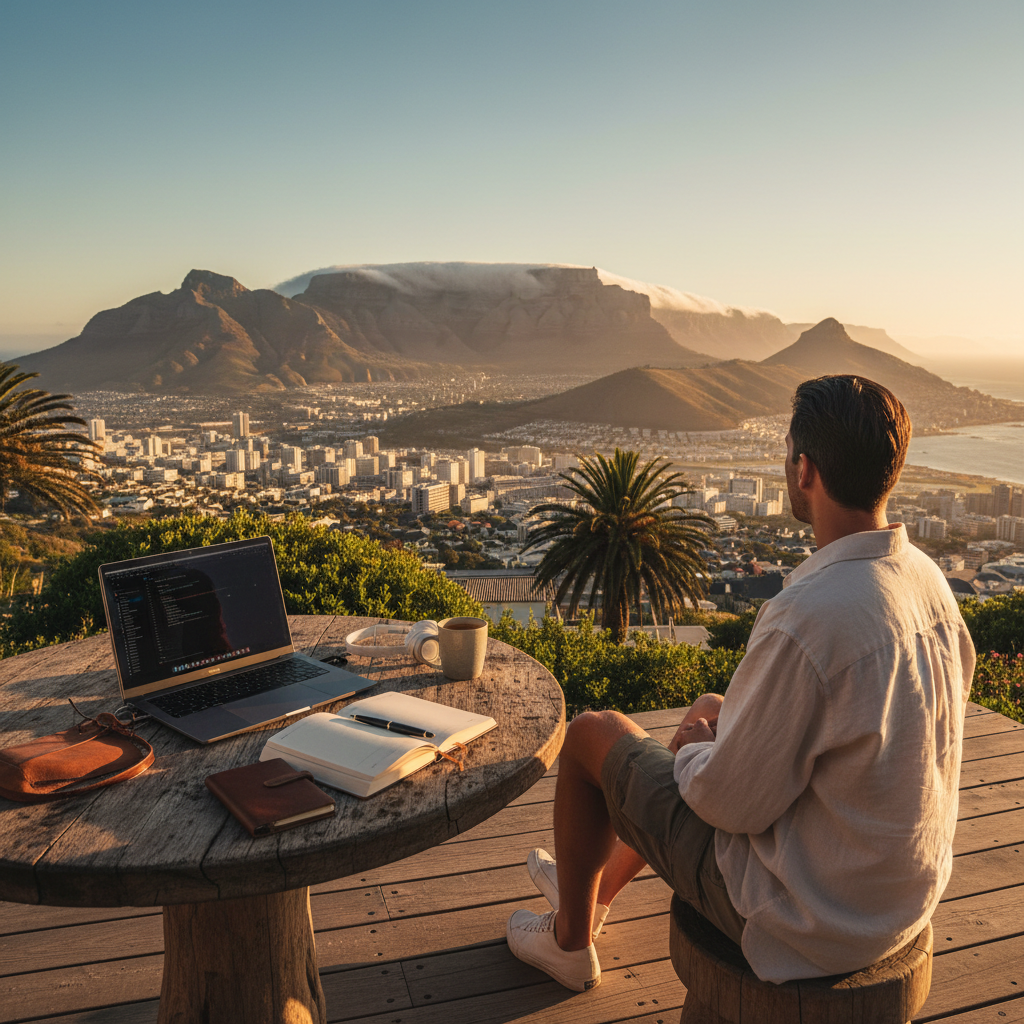
Imagine waking up to the smell of fynbos, the sound of cicadas, and the distant call of an ocean unique to the tip of Africa. Your morning coffee brewed, you plug in your laptop, ready to conquer your global tasks from a co-working space overlooking Lion's Head or perhaps a quiet corner in a beachfront apartment in Umhlanga. South Africa, with its breathtaking landscapes and vibrant culture, has emerged as a compelling destination for digital nomads. The launch of the South Africa digital nomad visa has opened its doors wider to the location-independent, but the true test of a remote-work haven lies beyond the scenery: it's in the robust backbone of connectivity, the efficiency of its workspaces, and the practicalities of trans-continental collaboration. In 2026, we’re taking an unvarnished look at South Africa's remote-work infrastructure, dissecting internet speeds, the burgeoning coworking scene, and strategic time zone advantages to see if this stunning country truly supports a frictionless digital nomad lifestyle.
Quick facts
| Row label | Data |
|---|---|
| Income requirement | ZAR 50,000/month (approx. USD 2,700/month or EUR 2,500/month) |
| Visa duration | Up to 12 months |
| Renewable | Yes, for up to an additional 12 months |
| Application fee | ZAR 4,250 (approx. USD 230 or EUR 210) – excluding VFS Global fees |
| Processing time | 4-8 weeks, can extend to 12 weeks |
| Tax rate for holders | Non-resident tax status if not physically present >183 days/year |
| Family members allowed | Yes, dependents can apply for an accompanying visa |
| Path to residency | No direct path via DNV; alternative visas required |
What is the South Africa digital nomad visa?
The South Africa digital nomad visa is a specialized permit designed for foreign nationals who earn their income from sources outside of South Africa and wish to reside and work remotely from within the country for an extended period. Launched to attract global talent and boost tourism, this visa allows individuals to legally stay for up to 12 months, with the possibility of renewal for an additional 12 months. It specifically targets those engaged in remote employment, freelancing for international clients, or running an online business that doesn't directly serve the South African market. The primary aim is to welcome individuals who can contribute to the local economy through their spending, without directly competing for local jobs. This visa is a game-changer for those seeking a longer-term immersion into South African life, far beyond the standard tourist visa limitations, providing stability and peace of mind for their location-independent lifestyle.
South Africa digital nomad visa requirements
To successfully secure the South Africa digital nomad visa, applicants must meet several key criteria, primarily revolving around financial stability and the nature of their work. The core requirements are:
- Proof of Remote Employment or Self-Employment: Applicants must provide compelling evidence that they are employed by a company registered outside of South Africa or are self-employed with clients based outside the country. This typically includes employment contracts, client agreements, business registration documents (if self-employed), and a letter from your employer confirming remote work allowance.
- Minimum Income Threshold: A crucial requirement is demonstrating a consistent minimum income of at least ZAR 50,000 per month (approximately USD 2,700 or EUR 2,500, though this fluctuates with exchange rates). This income must be derived from sources outside South Africa. You'll need bank statements for the past three to six months, pay stubs, or invoices to prove this. This threshold is designed to ensure you can support yourself without becoming a burden on local resources.
- Valid Passport: A passport valid for at least 30 days beyond your intended stay in South Africa, with at least two blank pages.
- Health Insurance: Comprehensive medical insurance coverage valid for the entire duration of your stay in South Africa, including repatriation.
- Clean Criminal Record: A police clearance certificate from your home country and any country you've resided in for more than 12 months in the last five years.
- Accommodation Proof: While not always strictly enforced at the initial application stage, having a confirmed booking for your initial stay (e.g., a hotel or Airbnb for the first few weeks) can strengthen your application.
- Return or Onward Ticket: Proof of booking for an onward or return ticket, or sufficient funds to purchase one.
Document Checklist Summary:
- Completed DHA-84 application form.
- Passport-sized photographs.
- Original passport.
- Proof of financial means (bank statements, payslips, employment contract).
- Letter from employer/clients confirming remote work and non-South African base.
- Comprehensive medical insurance policy.
- Police clearance certificates.
- Yellow Fever Vaccination Certificate (if travelling from or transiting through a high-risk country).
How to apply for the South Africa digital nomad visa
The application process for the South Africa digital nomad visa involves a few distinct steps, primarily facilitated through the Department of Home Affairs (DHA) and their appointed VFS Global centers. While the process can feel bureaucratic, meticulous preparation is key.
-
Gather Required Documents: This is the most crucial step. Refer to the list above and ensure every document is current, officially translated (if not in English), and ready for submission. Missing or incorrect documents are the primary cause of delays or rejections.
-
Complete the Online Application Form: While there isn't a dedicated 'digital nomad visa' portal per se, you'll typically use the standard temporary residence visa application form (DHA-84) and select the appropriate category or indicate your intention to apply for the digital nomad visa when prompted. The application is often initiated via the VFS Global website for your country of residence.
-
Schedule an Appointment: Once your online form is completed, you will need to schedule an appointment at your nearest VFS Global visa application center to submit your physical documents and provide biometric data (fingerprints and a digital photograph).
-
Attend Your Appointment and Submit Documents: Arrive on time with all original documents and their copies. The VFS Global staff will review your application for completeness and capture your biometrics. You will pay the application fee and the VFS Global service fee at this stage.
-
Await Processing: After submission, your application will be forwarded to the Department of Home Affairs for processing. Processing times can vary significantly but generally range from 4 to 8 weeks. Some applicants have reported delays extending to 12 weeks, so apply well in advance of your intended travel date.
-
Visa Notification and Collection: You will be notified by VFS Global once a decision has been made. You can then collect your passport with the visa sticker from the VFS Global center, or it may be couriered to you if you opted for that service.
It is highly recommended to consult the country's official immigration website and the VFS Global website for the most up-to-date forms, fees, and specific instructions relative to your country of application before beginning the process. This is particularly important for Bangladeshi applicants as specific VFS Global procedures may apply.
Cost breakdown
Understanding the financial outlay for the South Africa digital nomad visa is essential for budgeting. The costs generally fall into official fees, service charges, and associated expenses.
- Visa Application Fee: The primary fee payable to the Department of Home Affairs is ZAR 4,250 (approximately USD 230 / EUR 210, subject to exchange rates). This fee is non-refundable, regardless of the application outcome.
- VFS Global Service Fee: As VFS Global manages the application submission and biometrics process, they charge a separate service fee, which is typically around ZAR 1,800 (approx. USD 95 / EUR 90). This fee also varies by location and is subject to change.
- Medical Insurance: Costs for comprehensive health insurance can vary widely based on your age, health status, and desired coverage level. Expect to pay anywhere from USD 50 to USD 150 per month.
- Police Clearance Certificates: Obtaining police clearances from various countries can incur fees, postage, and translation costs, typically ranging from USD 20 to USD 100 per certificate.
- Document Translation/Attestation: If any of your supporting documents are not in English, they will need to be officially translated and possibly attested, adding to the cost. This could be USD 30-70 per document.
- Travel Costs: Factor in travel to the VFS Global center for your appointment, especially if you live far from a major city. For Bangladeshi digital nomads, this means travel to the VFS Global center in Dhaka. This and other costs like passport photos can amount to an additional USD 50-100.
Total Estimated Initial Costs: Expect to budget approximately USD 500 - USD 800 before you even arrive in South Africa, covering visa fees, VFS charges, and essential documentation. This excludes the ongoing cost of health insurance.
Remote-Work Infrastructure Review: Connectivity, Coworking, and Time Zones
South Africa is a country of contrasts, and its remote-work infrastructure reflects this. Major cities like Cape Town, Johannesburg, and Durban boast impressive capabilities, while rural areas can be more challenging. For the digital nomad, understanding these nuances is crucial.
Internet Speeds and Reliability
South Africa has made significant strides in broadband connectivity, particularly in urban centers. Fiber-to-the-Home (FTTH) is widely available in residential areas of major cities, offering speeds that rival many developed nations. You can easily find plans offering 100 Mbps, 200 Mbps, or even 1 Gbps symmetrical connections, with prices that are competitive by international standards.
- Average Download Speed (Fixed Broadband, mid-2026 estimate): 65-80 Mbps
- Average Mobile Download Speed (mid-2026 estimate): 30-45 Mbps
However, reliability can still be an issue due to frequent power outages (known locally as 'loadshedding'). While this has improved from its peak, digital nomads must be prepared. Many co-working spaces and some residential buildings now have robust backup power solutions (UPS systems, generators, solar), but it's a critical question to ask when choosing accommodation or workspaces. Mobile data networks (Vodacom, MTN, Telkom, Cell C) are strong in urban and semi-urban areas, providing a reliable backup. Purchasing a local SIM card with a data bundle is highly recommended upon arrival.
Coworking Spaces and Communities
The coworking scene in South Africa is vibrant and growing, especially in Cape Town and Johannesburg, which are hubs for tech and creative industries. These spaces offer not just high-speed internet and ergonomic setups but also invaluable networking opportunities and a sense of community.
Popular Coworking Chains/Spaces:
- Workshop17: One of the most established chains, with multiple locations across Cape Town (V&A Waterfront, Tabakhuis, Kloof Street) and Johannesburg (Rosebank, Sandton). Known for modern design, excellent facilities, and backup power.
- Spaces: International brand with locations in Cape Town (CBD, Loop Street) and Johannesburg (Rosebank). Offers flexible memberships and a professional environment.
- WeWork: A few locations in prime Johannesburg spots like Rosebank and Sandton, providing global standards of coworking.
- Cube Workspace: Several locations in Cape Town and Johannesburg, offering private offices and hot-desking options.
- Roam: A unique concept combining co-living and co-working, with a presence in Cape Town, popular with digital nomads.
Prices for hot-desking typically range from ZAR 1,500 - ZAR 3,500 per month (approx. USD 80 - USD 190), with private offices significantly higher. Most offer daily passes, meeting rooms, printing services, and, crucially, backup power.
Time Zone Advantage
South Africa operates on South African Standard Time (SAST), which is GMT+2. This offers a distinct advantage for digital nomads working with clients in Europe, the Middle East, and even parts of Asia. It's often a reasonable overlap with European working hours and an early start can even catch parts of the US East Coast workday.
| Region | Time Difference from SAST (GMT+2) |
|---|---|
| London (GMT) | -2 hours |
| Paris/Berlin (CET, GMT+1) | -1 hour |
| Dubai (GST, GMT+4) | +2 hours |
| Mumbai (IST, GMT+5:30) | +3.5 hours |
| New York (EST, GMT-5) | -7 hours |
| Los Angeles (PST, GMT-8) | -10 hours |
| Sydney (AEST, GMT+10) | +8 hours |
This time zone is particularly appealing to digital nomads managing projects or teams across continents, allowing for good synchronization without extremely early mornings or late nights.
Practicalities and Potential Pitfalls
While infrastructure is generally good, nomads should be aware of a few South Africa-specific challenges:
- Loadshedding: While backup solutions are common in business districts and newer buildings, it still necessitates proactive planning. Investing in a portable power bank for your laptop can be a lifesaver.
- Security: Like many developing nations, South Africa faces crime challenges. Prudent awareness, choosing secure accommodation, and using reputable transport are essential. However, digital nomads generally find well-established urban and tourist areas safe, especially in coworking environments.
- Cost of Living: While cheaper than Western Europe or North America, major cities like Cape Town can be surprisingly expensive, especially for rent in desirable areas. Budgeting is crucial.
- Language: While English is widely spoken, particularly in business and tourism, exposure to local languages (Zulu, Xhosa, Afrikaans) enriches the experience.
Taxes for digital nomads in South Africa
The tax implications for South Africa digital nomad visa holders are generally straightforward, provided they maintain their non-resident tax status. South Africa operates on a source-based tax system, meaning income sourced within South Africa is taxable. However, the digital nomad visa is specifically for individuals whose income is derived from foreign sources.
- Non-Resident Status: If you hold a digital nomad visa and your sole income is from outside South Africa, you are generally considered a non-resident for tax purposes, provided you do not spend more than 183 days in total in South Africa during a 12-month period, and are not physically present for more than 60 days in aggregate during that 12-month period, in addition to the 183-day rule for the current and following 5 years. This is critical. If you exceed these residency thresholds, you may become a tax resident and be liable for South African tax on your worldwide income.
- Foreign Income Exemption: As long as your income is genuinely sourced from outside South Africa, you will not be liable for South African income tax on that income. It's crucial to keep clear records of your income source and bank transfers.
- Local Spending: Any income earned from providing services within South Africa to South African clients would be taxable under South African law, even if you are a digital nomad visa holder.
It is highly recommended to consult with a tax professional specializing in international taxation or South African tax law to ensure full compliance with the South African Revenue Service (SARS) regulations and to avoid any unintended tax liabilities. This is particularly salient given the evolving nature of international tax treaties and digital nomad taxation.
For Bangladeshi passport holders
Bangladeshi citizens can apply for the South Africa digital nomad visa, following the same requirements and application process as other nationalities. The primary VFS Global center for South Africa visa applications for Bangladeshi residents is located in Dhaka. It's essential to meticulously prepare all documents and ensure they meet the specific requirements outlined by the South African Department of Home Affairs and VFS Global for applications originating from Bangladesh.
Key considerations for Bangladeshi applicants:
- Proof of Funds: Conversion rates for the ZAR 50,000 monthly income requirement should be carefully calculated from BDT or your primary currency. Providing strong evidence of consistent income flow through bank statements is crucial.
- Police Clearance: Obtain a police clearance certificate from Bangladesh. If you've lived in other countries, you'll need clearances from those too.
- Travel and Logistics: Factor in the travel time and costs to attend your VFS Global appointment in Dhaka. Ensure all documents are translated into English by an authorized translator, if necessary.
- Processing Time: While the general processing time is 4-8 weeks, anecdotal evidence suggests that applications from some regions can take longer. It's advisable for Bangladeshi applicants to submit their applications well in advance of their planned travel dates.
The South African High Commission in Dhaka or the VFS Global website specific to Bangladesh will provide the most precise details regarding document submission and specific local procedures.
Frequently asked questions
What is the South Africa digital nomad visa?
It's a temporary residence visa allowing foreign nationals to live and work remotely from South Africa for up to 12 months. Applicants must earn income from sources outside South Africa and meet financial thresholds.
Who is eligible for the South Africa digital nomad visa?
Individuals employed by companies outside South Africa or self-employed with international clients, earning at least ZAR 50,000 per month, with valid health insurance and a clean criminal record.
How much does the South Africa digital nomad visa cost?
The official application fee is ZAR 4,250, plus a VFS Global service fee of approximately ZAR 1,800. Additional costs for insurance, document preparation, and police clearances can range from USD 200-400.
How long does South Africa digital nomad visa processing take?
Processing generally takes between 4 and 8 weeks. However, some applications may extend to 12 weeks, making early submission advisable.
Can I bring my family on the South Africa digital nomad visa?
Yes, immediate family members (spouse, dependent children) can apply for an accompanying visa to join the principal digital nomad visa holder.
Do I pay tax in South Africa on the digital nomad visa?
Generally, no, if your income is from foreign sources and you maintain non-resident tax status by not exceeding 183 days of physical presence in any 12-month period, or 60 days in that 12-month period and the preceding 5 years.
Can Bangladeshi citizens get the South Africa digital nomad visa?
Yes, Bangladeshi citizens are eligible to apply for the South Africa digital nomad visa, following the standard application procedures and requirements through the VFS Global center in Dhaka.
Sources
- South African Department of Home Affairs: Please consult the country's official immigration website.
- VFS Global South Africa: Please consult the country's official immigration website.
- Ookla Speedtest Global Index: Data on internet speeds, available at www.speedtest.net/global-index.
- Various coworking space websites in South Africa (e.g., Workshop17, Spaces, WeWork South Africa).
- International tax advisory firms specializing in digital nomad taxation.
Compare with: Portugal, Mauritius, Croatia
Interested in applying for the South Africa visa?
Tell us a bit about yourself and we'll send tailored guidance on eligibility, paperwork, and next steps.