Unlocking Long-Term Remote Work: Why a Digital Nomad Visa Trumps a Tourist Stamp (Legally Speaking)
Discover the critical legal distinctions between a digital nomad visa and a tourist visa for long-term remote work. This guide clarifies income thresholds, tax implications, and residency pathways, ensuring you stay compliant and thrive abroad in 2026.
October 9, 2026
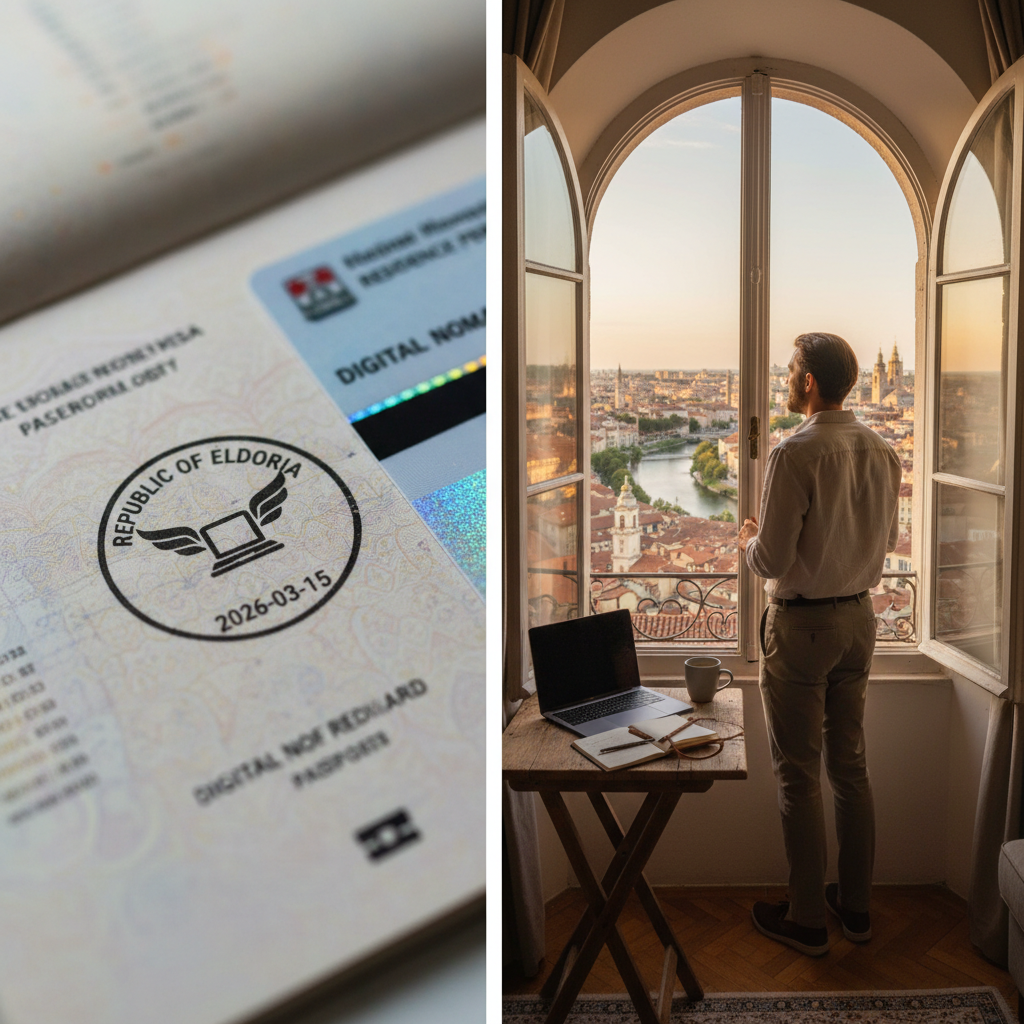
Ever found yourself sitting in a café in Bali, laptop open, earning a living for a company back home, all while on a standard tourist visa? It’s a common scenario for many aspiring digital nomads, often born out of convenience or a lack of awareness. But let's be blunt: it's a tightrope walk over a chasm of legal pitfalls. As the global landscape for remote work matures, relying on a tourist visa for your digital nomad lifestyle is becoming increasingly untenable, and frankly, risky. In 2026, with over 60 countries offering specific digital nomad visas, the question isn't just if you can work remotely, but how you can do it legally and sustainably.
This article isn't about the romantic notion of working from a beach. It's about the hard, cold legal realities that dictate whether your remote work journey is a seamless adventure or a bureaucratic nightmare. We'll peel back the layers to reveal why a legitimate digital nomad visa isn't just a convenience, but a necessity for anyone serious about a location independent lifestyle.
The Fundamental Shift: What Changes Legally with a Digital Nomad Visa?
At its core, a tourist visa is an implicit agreement with a host country: you are there for leisure, not to engage in economic activity. A digital nomad visa, however, is an explicit invitation. It's a country saying, "Come work here, contribute to our economy, and enjoy our culture, provided you meet certain criteria." This fundamental difference cascades into a multitude of legal and practical implications that can make or break your remote work dreams.
Permission to Earn vs. Prohibited Economic Activity
The most glaring difference lies in the right to earn. A tourist visa almost universally prohibits gainful employment or providing services within the host country. While working remotely for an employer outside the host country might seem like a grey area, many immigration laws view any work performed while physically present in their territory as an economic activity that requires a proper work permit or visa. The line is often blurred for tourism, but authorities are increasingly sophisticated in detecting individuals misusing tourist visas for extended stays while working.
A digital nomad visa, by contrast, explicitly grants you the right to perform remote work for clients or employers located outside the host country. This isn't a loophole; it's a designated legal status. Without this, even answering an email for your foreign client can technically be seen as a violation, potentially leading to fines, deportation, or future entry bans. For instance, in Portugal, a digital nomad visa holder (D7/D8) is legally sanctioned to perform their remote job, whereas a tourist engaging in the same activity is not.
Duration of Stay and Residency Pathways
Tourist visas are typically short-term, ranging from 30 to 90 days, with limited or no options for extension, especially if your initial stay was intended for work. Overstaying is a serious offense with severe consequences.
Digital nomad visas are designed for longer stays, usually 6 months to 2 years initially, with clear pathways for renewal, often contingent on maintaining the income requirements and good conduct. Crucially, many digital nomad visas, such as those in Spain, Portugal, or Greece, offer a pathway to temporary or even permanent residency after several years. This means your time spent working remotely can count towards obtaining long-term legal status, offering stability and integration that a tourist visa could never provide.
| Feature | Tourist Visa (e.g., Schengen) | Digital Nomad Visa (e.g., Spain, Portugal) |
|---|---|---|
| Purpose of Stay | Tourism, leisure, short visits | Remote work for foreign entities, living abroad |
| Work Legality | Prohibited (any gainful activity) | Explicitly allowed (remote work for foreign entities) |
| Duration | Typically 30-90 days, non-extendable for work | 6 months to 2 years initially, renewable |
| Income Source | Funds must originate outside the host country | Verified stable income from outside the host country |
| Minimum Income | Not applicable | Mandatory, often 2x-4x national minimum wage |
| Taxation | No tax residency typically established | Potential tax residency, favorable tax regimes (e.g., NHR, Beckham Law) |
| Healthcare Access | Travel insurance only, emergency care | Often requires local health insurance/system access |
| Banking | Limited to tourist accounts (if available) | Right to open local bank accounts |
| Family Inclusion | Separate tourist visas for family | Often allows dependents (spouse, children) on same visa |
| Residency Pathway | None | Common pathway to temporary/permanent residency |
| Penalties | Fines, deportation, future entry bans | Visa revocation if conditions not met (e.g., income) |
The All-Important Income Threshold
Tourist visas have no minimum income requirement beyond proving you can support yourself for your short stay. Digital nomad visas, however, universally demand proof of a stable, substantial income. This isn't arbitrary; it's designed to ensure you won't become a burden on the host country's social services and can contribute to its economy through your spending.
Example: In Spain (2026), the digital nomad visa requires an income of at least 200% of the national minimum wage, which currently stands at approximately €1,134/month. So, an applicant would need to demonstrate a consistent income of around €2,268 per month (approx. USD $2,450). For each dependent, this amount increases, typically by 75% for the first and 25% for subsequent family members. Failure to meet or maintain this threshold can lead to visa rejection or non-renewal.
Tax Implications and Compliance
This is where many aspiring digital nomads get into hot water. Working on a tourist visa might allow you to fly under the radar for a short period, but it's a ticking time bomb for tax compliance. Most countries have specific rules on tax residency, often triggered by spending 183 days or more within their borders within a 12-month period. Even if you're not earning locally, if you become a tax resident, you could be liable for taxes on your worldwide income, regardless of your visa status.
A digital nomad visa, by contrast, often comes with specific, sometimes favorable, tax regimes. Countries understand that attracting remote workers means offering competitive tax incentives. For example, Spain's Digital Nomad Visa often allows for a special tax regime (often referred to as the Beckham Law for certain professionals) that can significantly reduce your tax burden to a flat rate of around 24-25% on income up to €600,000 for the first few years, provided you meet certain conditions and haven't been a tax resident in Spain for the previous five years. This contrasts sharply with general income tax rates that can exceed 40-45% for high earners. This is a massive financial incentive and a legal framework that a tourist visa simply cannot provide.
Healthcare, Banking, and Social Services
On a tourist visa, you're reliant on private travel insurance for any medical emergencies. You typically cannot access the local public healthcare system, nor are you generally eligible to open a full-fledged local bank account, which can complicate receiving payments or managing daily expenses.
A digital nomad visa usually mandates comprehensive private health insurance, and in many cases, it grants access to the local public healthcare system after a certain period of contribution (often tied to tax payments or social security contributions). More importantly, it provides the legal standing to open local bank accounts, sign rental agreements, and access other essential services, integrating you into the local economy and society legitimately. This makes daily life infinitely smoother and more secure.
Family Inclusion
Bringing family members on a tourist visa means each individual must apply separately, and their stay is also limited to the tourist period. There's no inherent recognition of family units for long-term stays.
Most digital nomad visas include provisions for dependents – spouses, partners, and minor children. They can often be included in the primary applicant's visa application, allowing the entire family to reside legally in the host country for the duration of the visa. This is a game-changer for digital nomads with families, offering a cohesive legal status for everyone.
A Real-World Example: The Case of Maria from Bangladesh
Consider Maria, a freelance graphic designer from Dhaka, Bangladesh, who earns approximately $3,000 USD per month from international clients. She's always dreamed of living in Europe.
Scenario 1: Tourist Visa Roulette
Maria decides to try working from Italy on a 90-day Schengen tourist visa. She finds a beautiful Airbnb in Florence, sets up her laptop, and starts working. For the first month, it's idyllic. However, she quickly realizes a few issues:
- Legality: She’s technically violating her visa terms by engaging in economic activity, even for foreign clients. A strict border official or local authority could question her extensive laptop use and long stay, potentially leading to issues on exit or future entry bans.
- Duration: After 90 days, she has to leave the Schengen area. This means constant relocation, disrupting her workflow, and incurring significant travel costs. She can't establish any sense of home or community.
- Banking & Services: Her Bangladeshi bank account is functional, but she can't easily open a local Italian account, making paying local bills or receiving international transfers cumbersome. She relies solely on her travel insurance, which doesn't cover routine check-ups.
- No Path to Residency: Her 90 days in Italy don't count towards any long-term status. Each visit is a fresh start.
Scenario 2: Embracing the Spanish Digital Nomad Visa (2026)
Maria researches and applies for the Spanish digital nomad visa. She gathers her documents: proof of income (€3,000/month easily exceeds the €2,268 requirement), health insurance, criminal record check, and pays the application fee of around €80-€150 (plus processing at the consulate). After a processing time of approximately 30-45 days, her visa is approved.
- Legality: Maria can legally work remotely from Spain for her foreign clients for up to 1-2 years, with options to renew. No more looking over her shoulder.
- Duration & Stability: She obtains a residence permit, allowing her to stay for an extended period, establish routines, and integrate into a community. This stability is crucial for her productivity and mental well-being.
- Banking & Services: With her residence permit, she can open a Spanish bank account, easing financial management. She can access Spain's public healthcare system (after registering for social security contributions) or use comprehensive private insurance. She can sign a long-term rental agreement.
- Tax Benefits: Maria applies for the special tax regime, potentially paying a flat 24% income tax on earnings up to €600,000, significantly less than standard Spanish progressive rates.
- Residency Pathway: After 5 years of legal residency in Spain, Maria could be eligible to apply for permanent residency, opening up a future in Europe.
Maria's experience clearly illustrates the immense legal and practical advantages of opting for a digital nomad visa over the short-sighted approach of a tourist visa.
Cost Breakdown: Investment in Legality and Stability
While a tourist visa often involves only flight and accommodation costs, a digital nomad visa entails a specific set of fees. These aren't just expenses; they are an investment in your legal status, peace of mind, and long-term remote work viability.
| Item | Estimated Cost (USD, 2026) | Notes |
|---|---|---|
| Visa Application Fee | $80 - $300 | Varies significantly by country (e.g., Spain ~€80, Portugal ~€90) |
| Consular/Embassy Fee | $0 - $100 | Some countries levy an additional fee for processing. |
| Document Legalization | $50 - $200 per document | Apostille/notarization for background checks, marriage certs, etc. |
| Translation Services | $50 - $150 per document | Certified translations often required. |
| Comprehensive Health Insurance | $500 - $1,500 per year | Mandatory for most DN visas. |
| Criminal Background Check | $20 - $100 | Required from home country and sometimes previous residences. |
| Proof of Funds (Buffer) | $5,000 - $15,000 | Not a fee, but often a requirement to show savings for initial stay. |
| Legal/Immigration Consultant | $500 - $3,000 | Optional, but highly recommended for complex cases or peace of mind. |
| TOTAL ESTIMATED MINIMUM | $1,200 - $6,500 (initial) | Excludes consultant fees and proof of funds. |
These costs are upfront, but they unlock years of legal, stress-free remote work and potential pathways to long-term residency. Compare this to the hidden costs of tourist visa overstays, fines, or bans, which can be exponentially higher and career-damaging.
Taxes for Digital Nomads: Navigating the Global Financial Landscape
The tax implications are arguably the most complex and critical area where digital nomad visas provide clarity. Without a specific visa, you're operating in a grey area, potentially incurring tax liabilities in both your home country and the host country, without the benefit of double taxation agreements or special regimes designed for remote workers.
With a digital nomad visa, you gain access to a defined tax framework. This often means:
- Clear Tax Residency Rules: The visa itself helps establish your intent to reside, triggering specific tax residency rules. This can be beneficial for claiming tax relief or determining where your primary tax obligations lie.
- Favorable Tax Regimes: As discussed with Spain's Beckham Law, many countries offer reduced income tax rates for digital nomads for a set period (e.g., 5-10 years). This is a direct incentive to attract high-earning remote workers.
- Double Taxation Treaties (DTTs): Your visa status clarifies your residency for DTT purposes, preventing you from being taxed twice on the same income by two different countries. Without a clear visa, your tax residency can be ambiguous and subject to differing interpretations.
- VAT/GST Considerations: While often focused on income tax, a digital nomad visa also helps clarify your status regarding local consumption taxes (VAT/GST) if you ever provide services to local clients or register a local business. Most DN visas specifically cater to work for foreign entities, simplifying this.
It is imperative to consult with a tax professional specializing in international taxation for digital nomads. The nuances of DTTs, tax residency, and local tax laws can be complex and vary significantly by jurisdiction.
For Bangladeshi Passport Holders
Bangladeshi passport holders face particular challenges with traditional tourist visas, often requiring extensive documentation, proof of ties to Bangladesh, and a higher rate of rejection compared to some other nationalities. The 90-day Schengen limit is a constant hurdle, forcing frequent border runs or short, disruptive stays.
The advent of digital nomad visas offers a structured, transparent, and significantly more viable pathway for Bangladeshi citizens to experience long-term remote work abroad. While the income requirements might seem substantial compared to average earnings in Bangladesh, they are set to ensure self-sufficiency in the host country's economy.
Key Advantages for Bangladeshi Nomads:
- Enhanced Visa Success Rates: A digital nomad visa application is assessed on clear financial and professional criteria, offering a more predictable outcome than a discretionary tourist visa.
- Legal Work Status: No more ambiguity about working remotely while in a foreign country. This protects you from legal repercussions and future entry bans.
- Long-Term Stay: Permits stays for 1-2 years, allowing for genuine integration into a new culture without the constant pressure of short-term tourist visa limits.
- Family Inclusion: Enables Bangladeshi families to relocate together, which is often difficult or impossible on tourist visas.
- Path to Residency: For many, this visa can be the first step towards obtaining long-term residency in a European or other developed nation, a significant opportunity for Bangladeshi citizens seeking international opportunities.
While the application process for a digital nomad visa requires meticulous preparation and investment, it represents a profound shift towards greater accessibility and legality for Bangladeshi remote workers dreaming of a global digital nomad lifestyle. Consult the country's official immigration website or their embassy in Bangladesh for the most accurate and up-to-date requirements.
Conclusion: The Era of Legal Remote Work
The choice between a tourist visa and a digital nomad visa isn't just about semantics; it's about making a fundamental decision for your future as a remote worker. One offers a temporary, legally precarious glimpse into another country, while the other provides a legitimate, stable, and often tax-advantaged platform for building a sustainable location independent lifestyle. In 2026, with the proliferation of dedicated digital nomad programs, there's no longer a compelling reason to flirt with the legal grey areas of a tourist visa for long-term remote work. Embrace the clarity, stability, and benefits that come with a purpose-built visa, and truly unlock the world as your office.
Frequently Asked Questions
What is the legal difference between a digital nomad visa and a tourist visa?
A digital nomad visa explicitly permits remote work for foreign employers/clients while residing in the host country, whereas a tourist visa prohibits any form of gainful economic activity, even remote work, within its borders.
Who is eligible for a digital nomad visa?
Eligibility typically requires proof of stable income from foreign sources, a remote job or business, valid health insurance, a clean criminal record, and meeting specific income thresholds and duration of employment requirements.
How much does a digital nomad visa cost?
Application fees range from $80-$300, plus costs for document legalization, translations, and mandatory health insurance, typically totaling $1,200-$6,500 initially, excluding legal consultation fees.
How long does digital nomad visa processing take?
Processing times vary significantly by country and consulate, generally ranging from 2 weeks to 3 months, with some specialized visas taking longer due to increased demand or complex checks.
Can I bring my family on a digital nomad visa?
Yes, most digital nomad visas allow primary applicants to include dependents, such as spouses, partners, and minor children, in their application, granting them legal residence status too.
Do I pay tax in the host country on a digital nomad visa?
Yes, if you establish tax residency (often by staying over 183 days), you will likely pay taxes in the host country, sometimes under favorable special tax regimes for digital nomads.
Can Bangladeshi citizens get a digital nomad visa?
Absolutely. Bangladeshi citizens are eligible to apply for digital nomad visas offered by various countries, provided they meet all the specific income, employment, and documentation requirements of the destination country.
Sources
- Spanish Ministry of Inclusion, Social Security and Migration – Immigration Portal
- Portuguese Immigration and Borders Service (SEF) / AIMA
- European Commission – Visa Policy
- Official Government websites of various digital nomad visa offering countries (e.g., Greece, Malta, Italy, Croatia)
- PwC Global Mobility Tax Guides (2025-2026 Editions)
Compare with:
Spain, Portugal, Greece
Interested in applying?
Tell us a bit about yourself and we'll send tailored guidance on eligibility, paperwork, and next steps.