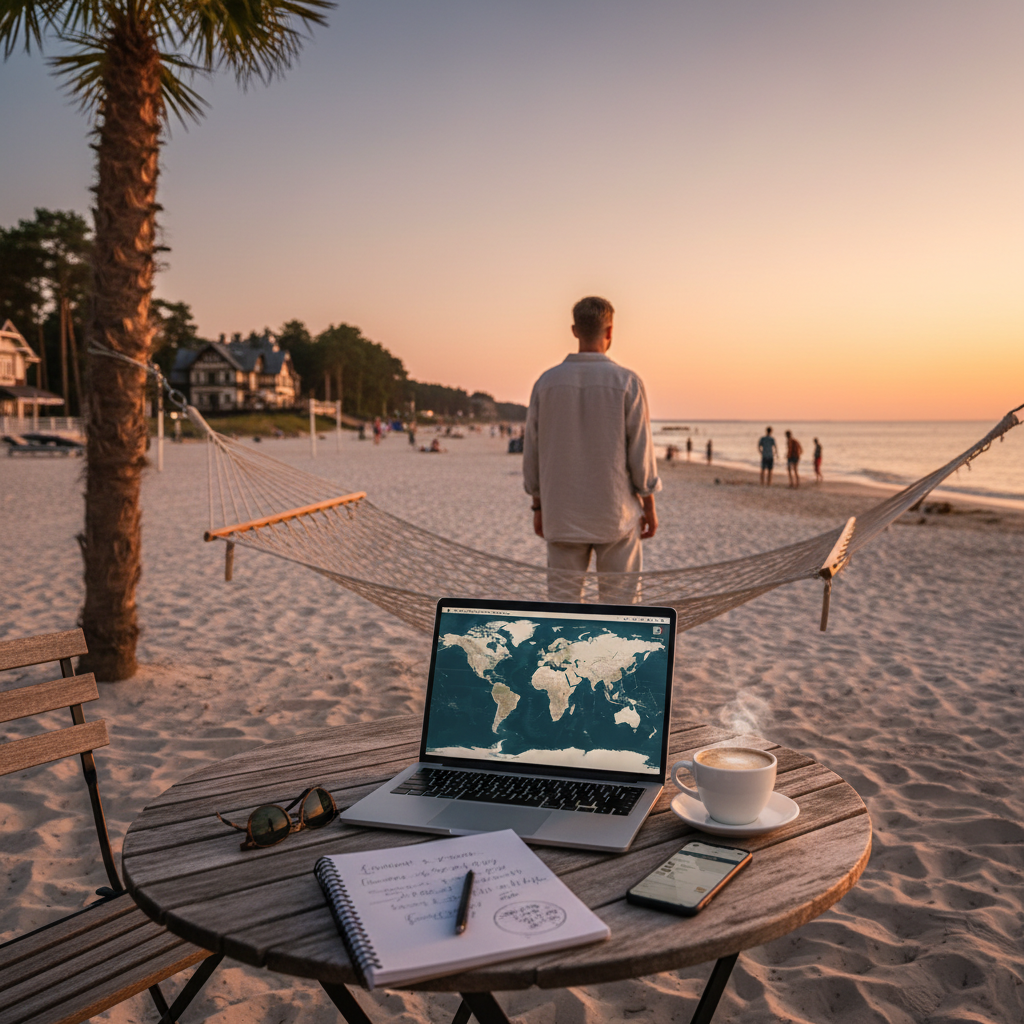
UAE Digital Nomad Visa 2026: A Family's Gateway to the Emirates
Considering working remotely from the gleaming towers of Dubai or the cultural heart of Abu Dhabi with your loved ones? The UAE's Digital Nomad Visa offers a compelling, albeit premium, pathway for families. This comprehensive guide navigates the intricacies of bringing dependents, finding schools, accessing healthcare, and understanding the financial commitments for a truly enriching remote work experience in 2026.
June 8, 2026

The United Arab Emirates (UAE) Digital Nomad Visa in 2026 is a strong contender for remote professionals yearning to combine their Location Independent Lifestyle with a family-friendly environment, provided they meet the robust financial requirements. While certainly not the cheapest option, the UAE offers unparalleled infrastructure, world-class education and healthcare, and a secure, diverse society that can make this a truly rewarding move for Digital Nomads with dependants.
Why the UAE for Your Digital Nomad Family?
The UAE, particularly Dubai and Abu Dhabi, has continuously positioned itself as a global hub for innovation, business, and luxury living. For remote work professionals with families, this translates into tangible benefits:
- Safety and Security: The UAE boasts exceptionally low crime rates, consistently ranking among the safest countries in the world. This peace of mind is invaluable for parents.
- World-Class Education: From nurseries to international schools following various curricula (British, American, IB, Indian, etc.), the education sector is highly developed, albeit often expensive. You'll find institutions catering to every age and academic need.
- Excellent Healthcare: Private healthcare facilities in the UAE are state-of-the-art, with highly qualified medical professionals and cutting-edge technology. Comprehensive health insurance is mandatory and widely available.
- Diverse Expat Community: You'll be joining a vast, multicultural expat community, making it easier for children and adults alike to integrate and find social connections.
- Connectivity and Infrastructure: High-speed internet, efficient transport, and modern amenities are standard, supporting a seamless Digital Nomad Lifestyle.
- Strategic Location: Situated at the crossroads of East and West, the UAE offers easy access for travel to Europe, Asia, and Africa, perfect for those with a global outlook.
Eligibility Requirements for the UAE Digital Nomad Visa 2026
To qualify for the UAE's Digital Nomad Visa (formally known as the Virtual Work Residency Permit), applicants must adhere to specific criteria designed to attract high-earning, self-sufficient individuals. This applies to the primary applicant, with subsequent rules for dependents.
Primary Applicant Criteria:
- Employment Status: You must be employed remotely by a company outside the UAE, or own a successful Online Business that can be operated Work From Anywhere.
- Valid Passport: A passport valid for at least six months from the date of application.
- Proof of Employment: If employed, a valid employment contract from a company outside the UAE. The contract should demonstrate that your role can be performed remotely.
- Minimum Monthly Income: This is a crucial threshold. Applicants must prove a minimum monthly income of USD 5,000 (approximately AED 18,365). This can be evidenced by bank statements for the last three to six months, showing consistent income, or salary slips.
- Company Longevity: If employed, the company must have been established for at least one year. If you are a Freelancing professional or Digital Entrepreneurship running your own business, you'll need to show proof of business ownership for at least one year.
- Health Insurance: Proof of comprehensive health insurance valid in the UAE, covering the applicant and any dependents, for the entire duration of their stay.
Dependent Family Members:
Children under 18 years of age and spouses are typically eligible to be sponsored under the primary applicant's Digital Nomad Visa. For spouses, a marriage certificate is required. For children, birth certificates are necessary. Each dependent will also need proof of health insurance valid in the UAE.
The Financials: Fees and Income Thresholds (2026)
The UAE Digital Nomad Visa comes with a clear, albeit premium, price tag. It's essential to budget thoroughly for both application fees and the ongoing cost of living.
Application Fees:
The primary fee for the Virtual Work Residency Permit is typically around AED 250 (approximately USD 68 / EUR 62) for the initial application, plus additional services and processing fees. However, this is largely an administrative fee. The significant costs come from other necessary components.
- Visa Processing Fee: Approximately AED 250 (USD 68)
- Entry Permit Fee: Around AED 100-200 (USD 27-54)
- Status Adjustment Fee: If applying from within the UAE, approximately AED 500-1000 (USD 136-272)
- Emirates ID (3-year validity): Approximately AED 370 (USD 101) per person (including dependents)
- Medical Examination: Mandatory for all applicants including dependents over a certain age (usually 18), typically AED 250-500 (USD 68-136) per person depending on the clinic.
- Health Insurance: Varies significantly based on age, coverage, and family size. Expect to pay anywhere from AED 3,000 to AED 15,000+ (USD 817 - 4,085+) annually per person for good family coverage. This is a crucial ongoing cost.
Total Estimated Initial Costs (excluding health insurance): For a single applicant, expect roughly AED 1,000 - 1,500 (USD 272 - 408). For a family of four (two adults, two children under 18), this could amount to AED 3,000 - 5,000 (USD 817 - 1,360), plus the significant health insurance premiums.
Income Threshold
As mentioned, the primary applicant must demonstrate a consistent monthly income of at least USD 5,000 (AED 18,365) for the last three to six months. This threshold must be maintained throughout your residency.
Step-by-Step Application Process (2026)
The application for the UAE Digital Nomad Visa can be done entirely online or through official service centers. The process is generally streamlined and efficient.
-
Gather Required Documents:
- Scanned copy of passport (main applicant and all dependents).
- Recent passport-sized photographs (digital format).
- Proof of employment/business ownership (employment contract, company incorporation documents, trade license).
- Bank statements (last 3-6 months) showing the USD 5,000+ monthly income.
- Educational qualifications (degree certificates, if applicable, though not always mandatory for this visa).
- Marriage certificate (for spouse).
- Birth certificates (for children).
- Proof of comprehensive health insurance valid in the UAE.
- Curriculum Vitae (CV).
-
Initial Application Submission:
- Access the official General Directorate of Residency and Foreigners Affairs (GDRFA) website for the relevant Emirate (e.g., DubaiNow app for Dubai, or ICP website for other Emirates) or visit an Amer/Tasheel service center.
- Fill out the online application form for the Virtual Work Residency Permit.
- Upload all supporting documents.
- Pay the initial application fee.
-
Await Initial Approval:
- The immigration authorities will review your application. This phase typically takes 5-10 business days.
- If approved, you'll receive an entry permit (e-visa) to enter the UAE.
-
Entry to the UAE and Status Adjustment:
- Enter the UAE using your entry permit. You will typically be granted a 30 or 60-day window to complete the final steps.
- Undergo a mandatory medical fitness test (blood test and X-ray) at an approved medical center in the UAE. This is required for all applicants and dependents applying for residency.
- Apply for your Emirates ID card at an authorised center (typing center or ICP customer happiness center). Biometric data (fingerprints, iris scan) will be collected.
-
Final Visa Stamping:
- Once your medical test results are cleared and your Emirates ID application is processed, your Digital Nomad Visa (residency stamp) will be affixed to your passport.
- Your physical Emirates ID card will be couriered to you.
Processing Time
From the initial online submission to receiving your Emirates ID and visa stamp, the entire process might take 3-6 weeks if all documents are in order and there are no unforeseen delays. The online application and entry permit can be as fast as 5-10 days, with in-country procedures adding the majority of the time.
Tax Treatment for Digital Nomads in the UAE
One of the most attractive aspects of the UAE for any Digital Nomad is its favorable tax regime. The UAE generally does not impose personal income tax on salaries and business income. This means your remote earnings in the UAE are tax-free at the federal level.
- No Personal Income Tax: This is a significant advantage, as your entire pre-tax income can be utilized for your lifestyle and family expenses.
- Corporate Tax: For businesses, the UAE introduced a federal corporate tax of 9% on taxable profits exceeding AED 375,000 (approximately USD 102,000) effective June 1, 2023. If your Online Business generates profit above this threshold and you are running it as a UAE-registered entity, you might be subject to this tax. However, if you are purely operating as a remote employee for an international company or a freelancer under your personal virtual work permit, this tax typically does not apply directly to your personal income.
- Value Added Tax (VAT): A 5% VAT is applied to most goods and services in the UAE. This is an indirect consumption tax, similar to sales tax in other countries.
Regional Note (Bangladesh): For Freelancing Bangladesh professionals considering the UAE Digital Nomad Visa, the tax-free income can be a massive benefit compared to income tax rates in Bangladesh. However, it's crucial to understand your tax obligations in your home country (Bangladesh) regarding earnings generated while residing abroad. Many countries have tax treaties or rules regarding tax residency that might still require you to declare or pay tax on your global income, even if you are not taxed in the UAE. Always consult with a qualified tax advisor in both the UAE and your home country (e.g., Bangladesh) to ensure full compliance.
Bringing Family & Dependents: The Heart of Your Relocation
Successfully relocating as a Digital Nomad with family hinges on understanding the specifics for dependents. The UAE makes this relatively straightforward, but planning is key.
Sponsorship and Documentation:
As the primary applicant, you will sponsor your spouse and children. Required documents include:
- Original attested marriage certificate (for spouse), translated into Arabic if not already in English.
- Original attested birth certificates (for children), translated into Arabic if not already in English.
- Passport copies and passport-sized photos for all dependents.
- Proof of comprehensive health insurance for each dependent.
Attestation: Crucially, all foreign-issued marriage and birth certificates must be attested by the UAE Embassy in your home country and then by the Ministry of Foreign Affairs (MoFA) in the UAE. This process can be time-consuming and incur additional costs (AED 150-200 per document at MoFA, plus fees in your home country). Start this well in advance.
Education: Finding the Right School
The UAE's private education sector is robust but competitive and expensive. Annual fees for international schools can range from AED 25,000 to AED 100,000+ (USD 6,800 - 27,200+) per child, per year, depending on the curriculum, reputation, and grade level. Consider these factors:
- Curriculum: British, American, IB, Indian, French, German are widely available.
- Location: Proximity to your chosen residence is important for daily commutes.
- Accreditation and Reputation: Research school ratings and parent reviews.
- Waiting Lists: Popular schools can have long waiting lists, especially for younger grades. Apply early!
- Entry Requirements: Many schools require entrance exams and interviews.
There are no public schools available for expat children in the UAE; private education is the only option.
Healthcare: Ensuring Peace of Mind
Comprehensive health insurance is not just a requirement; it's a necessity for your family's well-being. The quality of care is excellent, but costs can be high without good insurance.
- Mandatory: Every resident, including dependents, must have valid health insurance.
- Coverage Levels: Policies vary widely. Ensure yours covers inpatient, outpatient, emergency, maternity (if applicable), and even dental/optical if desired.
- Network: Check if your chosen policy covers a wide network of hospitals and clinics convenient to your home.
- Annual Renewals: Budget for annual renewal of policies, which may increase with age or claims history.
Comparison Table: UAE vs. Popular Family-Friendly Nomad Hubs (Simplified)
| Feature | UAE (Dubai/Abu Dhabi) | Portugal (Lisbon/Porto) | Thailand (Chiang Mai/Phuket) |
|---|---|---|---|
| Visa Name | Digital Nomad (Virtual Work Permit) | D7/Digital Nomad Visa | LTR (Digital Nomad) Visa |
| Primary Income Req. | USD 5,000 / month (AED 18,365) | ~EUR 3,200-4,000 / month (family) | USD 80,000 / year (single) |
Family Inclusion (Dep.) | Yes (Spouse, Children under 18) | Yes (Spouse, dependent children/parents) | Yes (Spouse, dependent children under 20) |
| Education Cost (Annual) | High (AED 25k-100k+ per child) | Mid (EUR 5k-15k+ per child) | Mid (THB 100k-400k+ per child) |
| Healthcare Quality | Excellent (Private) | Good (Public/Private) | Good (Private) |
| Tax on Remote Income | 0% personal income tax | 20% (NHR option, if applicable) | 0% (if taxed outside Thailand) |
| Cost of Living (Family) | High | Mid-High | Low-Mid |
| Safety & Security | Extremely High | High | Medium-High |
| Processing Time | 3-6 weeks | 3-6 months | 4-8 weeks |
| Culture | Modern, Multicultural, Conservative | European, Rich History | Southeast Asian, Buddhist |
Note: Income requirements are approximate and subject to change. Always verify current official figures. For Remote Work Bangladesh individuals, comparing these options based on financial obligations and family support is essential for making an informed decision about the best Work From Anywhere destination.
UAE-Specific Pitfalls for Families
While the UAE offers many advantages, it's wise to be aware of potential challenges:
- High Cost of Living: Beyond school fees, rent, utilities, and daily expenses, particularly in Dubai and Abu Dhabi, can be significantly higher than in many other nomad destinations. A realistic budget is paramount.
- Cultural Differences: While generally liberal, the UAE is a Muslim country with conservative cultural norms. Public displays of affection are discouraged, and dress codes should be respected, especially in religious sites. Educating children about these nuances is important.
- Heat (Summer Months): Summers (June to September) are extremely hot and humid, with temperatures often exceeding 40°C (104°F). Outdoor activities become limited during this period.
- Transit Culture: The car is king. While public transport is improving, particularly in Dubai, reliance on personal vehicles or taxis is common, which might be a change for those used to walking or cycling.
- Bureaucracy (Attestation): As mentioned, the attestation of documents can be a cumbersome and costly process. Allow ample time.
- Dependence on Employer Sponsorship: The digital nomad visa offers more independence than traditional employment visas, but the permit itself is tied to your ability to prove ongoing remote income. Losing your remote job or significant reduction in income would jeopardize your residency.
Renewals and Long-Term Stay
The UAE Digital Nomad Visa is typically issued for one year. It is renewable, provided you continue to meet the eligibility criteria, particularly the minimum income threshold and valid health insurance. The renewal process is similar to the initial application, requiring updated documentation and fees. This allows for a truly long-term Digital Nomad Lifestyle for families who find their rhythm in the Emirates.
Conclusion: A Family's Digital Nomad Dream (with preparation)
The UAE Digital Nomad Visa in 2026 presents an exceptional opportunity for Digital Nomad Families to experience a high-quality lifestyle, world-class amenities, and a safe, stable environment. While the financial commitment is substantial, the benefits — from tax-free income and premium education to outstanding healthcare and a diverse community — can far outweigh the costs for those who qualify. Detailed planning, especially regarding schooling and healthcare for dependents, is non-negotiable. For the prepared and well-resourced remote professional, the UAE truly offers a glittering platform to cultivate a flourishing Location Independent Lifestyle for their entire family.
Frequently Asked Questions (FAQ)
Q1: Is the USD 5,000 monthly income requirement negotiable or flexible for families?
A1: No, the USD 5,000 (AED 18,365) monthly income threshold is a strict prerequisite for the primary applicant. There are no published flexibilities or family-specific adjustments to this amount. You must consistently demonstrate this income. For families, while the primary applicant fulfills this, you also need to budget for the higher cost of living and additional expenses like school fees and multiple health insurance policies.
Q2: Can my parents also be sponsored under my UAE Digital Nomad Visa?
A2: The standard Digital Nomad Visa typically only allows for the sponsorship of a spouse and minor children (under 18). Sponsoring parents usually falls under different visa categories, often requiring higher income thresholds and potentially a security deposit, and is generally more aligned with traditional employment visas. It's best to consult the country's official immigration website or a local PRO service for the latest rules on sponsoring parents.
Q3: What is the age limit for children to be sponsored on the Digital Nomad Visa in the UAE?
A3: Generally, children can be sponsored until they are 18 years old. In some cases, if a child is enrolled full-time in higher education within the UAE, sponsorship can be extended until they are 21 years old, but this requires specific documentation from the educational institution. Always confirm current age limits with official sources, as rules can be updated.
Q4: Are there any specific schools or education subsidies for expat children under the Digital Nomad Visa?
A4: No, there are no specific government-provided schools or education subsidies for expat children in the UAE. All expat children attend private schools, and parents are responsible for the full tuition fees, which can be considerable. It's essential to factor these costs into your budget well in advance.
Q5: What happens if I lose my remote job or my income drops below the threshold while on the UAE Digital Nomad Visa?
A5: Your Digital Nomad Visa is contingent upon meeting the eligibility criteria, including the minimum income threshold. If your remote employment ceases or your income consistently falls below USD 5,000, you risk jeopardizing your visa status and that of your dependents. It's crucial to maintain your financial stability. You would typically have a grace period to either find new employment, regularize your status, or leave the country before your visa is cancelled.
Sources
- Federal Authority for Identity, Citizenship, Customs & Port Security (ICP) Official Website.
- General Directorate of Residency and Foreigners Affairs (GDRFA) Dubai Official Website.
- DubaiNow Application (for Dubai-specific services).
- UAE Ministry of Finance Official Website (for corporate tax information).
- Independent Immigration Consultants in the UAE (e.g., those specializing in virtual work permits for current 2026 regulations).
- Reports from reputable financial and expat services firms on UAE cost of living and education fees (e.g., Mercer, Numbeo data for 2025/2026 projections).
- Discussions with current Digital Nomad and expat families residing in the UAE (anecdotal, but critical for real-world perspectives).
Always consult the country's official immigration website or an authorized legal professional for the most current and definitive information regarding visa policies and requirements.
Interested in applying for the United Arab Emirates visa?
Tell us a bit about yourself and we'll send tailored guidance on eligibility, paperwork, and next steps.