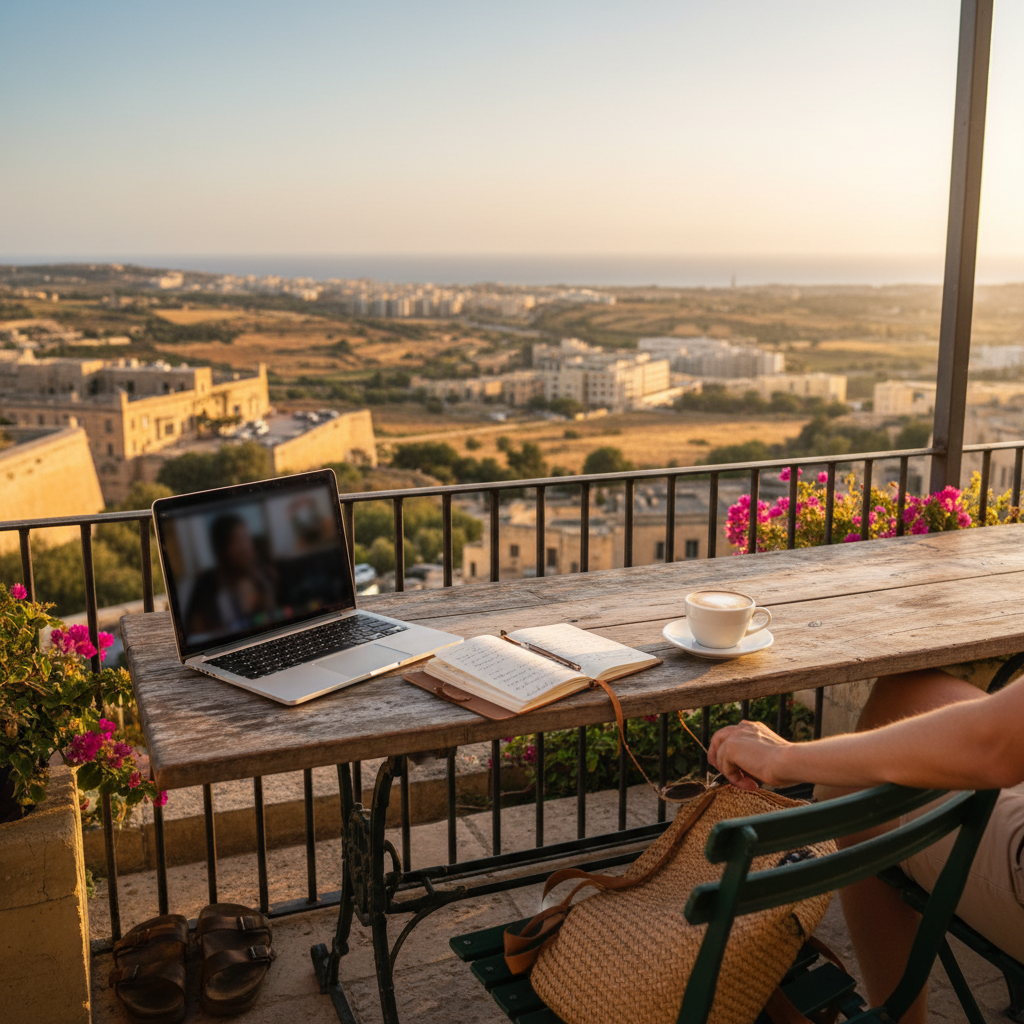
Portugal Digital Nomad Visa: Your 2026 Comprehensive Guide
Explore the nuances of Portugal's Digital Nomad Visa (D8/D7 variant) for 2026. This comprehensive guide details eligibility, income requirements, application procedures, costs, tax implications, and the unique advantages and disadvantages of choosing Portugal as your remote work hub.
May 25, 2026

Overview
Portugal has firmly established itself as a premier destination for digital nomads, largely due to its welcoming culture, vibrant cities, stunning coastline, favorable climate, and competitive cost of living compared to other Western European nations. Recognizing the economic potential and growing global trend of remote work, Portugal officially launched its dedicated Digital Nomad Visa in October 2022, effectively creating a specific pathway for remote workers to reside legally in the country for up to a year, with the possibility of extension or conversion to a long-term residence permit. Prior to this, many digital nomads utilized the D7 (Passive Income) Visa, but the new D8 visa, often still referred to in conjunction with D7 due to its lineage and similar requirements, is tailored specifically for those earning income from outside Portugal directly through employment or self-employment. This guide provides a comprehensive overview of the Portuguese Digital Nomad Visa as of 2026, offering detailed insights into eligibility, application processes, costs, tax considerations, and more.
The visa allows non-EU/EEA/Swiss citizens to legally live and work remotely from Portugal for up to one year, with the option to convert it into a D8 Residence Permit for a longer stay. This path is distinct from the D7 Passive Income Visa, which primarily caters to individuals with stable international passive income (e.g., pensions, rents, investments). The Digital Nomad Visa is designed for those actively employed by a foreign company or operating as independent contractors/freelancers with foreign clients. Its introduction solidified Portugal's commitment to attracting a diverse pool of international talent and further cementing its status as a digital nomad hotspot.
Who Qualifies
To qualify for the Portuguese Digital Nomad Visa (officially known as the Visa for the Exercise of Professional Activity Remotely or D8), applicants must meet specific criteria primarily revolving around their employment status and income source. The visa is explicitly for third-country nationals, i.e., citizens from non-EU, non-EEA, and non-Swiss countries.
Key Qualification Criteria:
- Non-EU/EEA/Swiss Citizenship: This visa is not available to citizens of the European Union, European Economic Area, or Switzerland, as they already have the right to live and work in Portugal under EU freedom of movement laws.
- Remote Work: The applicant must prove they are employed by a company outside Portugal or are self-employed/freelance with clients located outside of Portugal. The nature of the work must be fully remote, meaning it can be performed from Portugal without requiring a local employer.
- Minimum Income Threshold: This is a crucial requirement. Applicants must demonstrate a monthly income of at least four times the Portuguese minimum wage. As of early 2026, with potential adjustments, the Portuguese minimum wage is expected to be around €880-€900 per month. Therefore, applicants should anticipate needing to show a stable gross monthly income of approximately €3,520 - €3,600 or more (4 x minimum wage). This income must be consistently earned for the three to six months prior to the application. This threshold may increase with future adjustments to the minimum wage, so it's vital to check the most current figure.
- Proof of Employment/Client Contracts: Salaried employees must provide an employment contract or a declaration from their employer confirming their remote work status, position, and salary. Freelancers or independent contractors must provide documented proof of their service provision to one or more companies outside Portugal, such as service contracts, invoices, or client declarations, along with evidence of consistent payments.
- Clean Criminal Record: Applicants must have a clean criminal record from their country of origin and any country they have resided in for more than one year.
- Accommodation in Portugal: Proof of accommodation in Portugal for at least the duration of the initial visa (e.g., rental agreement, property deed) is required. This can be a short-term rental for the visa application, but a long-term lease will be needed for the residence permit application in Portugal.
- Sufficient Funds: In addition to the monthly income, applicants should demonstrate sufficient funds to cover their initial stay in Portugal, typically equivalent to 12 months of the minimum wage, which would be around €10,560 - €10,800. This is to ensure you can support yourself upon arrival.
Dependents (spouse/partner, minor children, dependent adult children, dependent parents) can also apply to join the main applicant, provided they meet their own set of requirements and the main applicant can prove sufficient additional financial means to support them. Each additional adult dependent typically requires an extra 50% of the minimum wage in income proof, and each child requires an additional 30%.
Requirements
Beyond the qualification criteria, specific documentation requirements must be meticulously prepared for a successful application. These documents are generally required for both the initial visa application at the consulate/embassy and for the subsequent residence permit application in Portugal.
General Documentation List (Subject to local consulate variations):
- Application Form: Duly filled and signed national visa application form.
- Passport: Valid passport or travel document, valid for at least three months beyond the intended stay, with at least two blank pages, issued within the last 10 years.
- Photos: Two recent passport-sized photographs, in color, plain background, good condition, and identified.
- Travel Insurance: Proof of valid travel insurance covering medical emergencies, urgent hospitalization, and repatriation, with coverage of at least €30,000, valid for the entire duration of the initial stay.
- Criminal Record Certificate: A criminal record certificate issued by the relevant authority of your country of origin and any country where you have resided for more than one year (for adults aged 16 and over). This certificate must be apostilled or legalized and translated into Portuguese by a certified translator.
- Authorization for Criminal Record Check: A signed authorization for SEF (now AIMA) to access your criminal record in Portugal.
- Proof of Accommodation: Lease agreement, property deed, or declaration of accommodation from a host in Portugal (with a copy of their ID).
- Proof of Financial Means:
- Bank statements from the last 3-6 months. All statements should clearly show income deposits.
- For employees: Employment contract and a declaration from the employer confirming remote work, position, and monthly salary.
- For self-employed/freelancers: Service provision contracts, evidence of directorship in a foreign company, invoices, tax returns, and bank statements showing consistent income from foreign clients.
- Proof of sufficient additional funds to cover the initial 12 months of stay (e.g., bank statements showing €10,560 - €10,800 in savings, in addition to regular income).
- Proof of Tax Residence: Documentation proving tax residence outside Portugal for the duration of the remote work activity.
- Flight Itinerary: Proof of travel arrangements (e.g., flight reservation).
- Marriage Certificate/Birth Certificates (for dependents): If applying with family, these documents, fully apostilled/legalized and translated, will be required.
Important Note on Translations and Apostilles: All foreign documents (e.g., criminal record, marriage certificates, birth certificates) must be apostilled or legalized by the Portuguese Embassy/Consulate in the issuing country and translated into Portuguese by a sworn translator, unless the consulate specifies otherwise.
Application Process
The application for the Portuguese Digital Nomad Visa primarily consists of two main stages:
Stage 1: Applying for the D8 Visa at a Portuguese Consulate/Embassy Abroad
- Gather Documents: Collect all required documents as outlined in the 'Requirements' section. Ensure all foreign documents are apostilled/legalized and translated into Portuguese where necessary.
- Book an Appointment: Schedule an appointment at the Portuguese Embassy or Consulate responsible for your place of residence. Demand for these appointments can be high, so plan accordingly.
- Submit Application: Attend the appointment, submit your application form, financial proof, accommodation details, criminal record, and all other supporting documents. Pay the visa application fee.
- Interview (Possible): Some consulates may conduct a brief interview to clarify details of your application.
- Wait for Decision: The consulate will process your application. The processing time can vary significantly depending on the consulate's workload. Once approved, your passport will be stamped with a D8 visa, valid for 120 days (4 months) and allowing for two entries.
Stage 2: Applying for a Residence Permit (Autorização de Residência) in Portugal
Upon arrival in Portugal with your D8 visa, the next critical step is to apply for your residence permit. This is done with the Agency for Integration, Migrations and Asylum (AIMA), which replaced SEF in 2023.
- Schedule AIMA Appointment: Often, the consulate will pre-schedule an AIMA appointment for you upon visa approval, or you may need to schedule it yourself shortly after arriving in Portugal. It is crucial to attend this appointment within the 120-day validity of your initial visa.
- Prepare Documents for AIMA: While many documents will be the same as your visa application, AIMA may require more updated versions (e.g., a new criminal record check if the previous one is nearing expiry), and original copies are paramount. You will also need your NIF (tax identification number), a Portuguese bank account, and proof of health insurance (if not already covered by national health services after registration).
- Attend AIMA Interview: During this appointment, you will submit all your documents, provide biometric data (fingerprints and photo), and potentially answer questions about your stay and work in Portugal. Pay the residence permit application fee.
- Receive Residence Permit: If approved, you will typically receive your residence permit card by mail to your Portuguese address within a few weeks to a few months. The initial residence permit is usually valid for two years.
Renewal:
After the initial two-year residence permit, you can apply for renewal for another three years. After five years of legal residency in Portugal, you may be eligible to apply for permanent residence or Portuguese citizenship, provided you meet other requirements such as basic Portuguese language proficiency.
Costs & Duration
Understanding the financial commitments and timelines is crucial for planning your move to Portugal.
Application Costs:
- Visa Application Fee: Approximately €90-€100 (payable at the consulate).
- Residence Permit Application Fee: Approximately €80-€150 (payable at AIMA).
- Criminal Record Certificates & Apostilles/Legalizations: Varies by country, but budget €50-€200 per document.
- Certified Translations: €20-€50 per page, depending on the document length and language pair.
- Travel Insurance: €200-€600 for a year, depending on coverage and age.
- NIF (Tax ID) & Bank Account: Opening these typically has no direct cost, but some agencies may charge a fee if you use their assistance.
- Accommodation Deposit: You will need funds for a rental deposit (typically 1-3 months' rent) and first month's rent.
- Proof of Funds: You must show evidence of roughly €10,560 - €10,800 in a bank account on top of your ongoing monthly income.
Total upfront costs, excluding the minimum wage proof of funds and rental deposit, could easily range from €500 to €1,500 for a single applicant, factoring in all administrative and documentation expenses.
Processing Duration:
- Visa Processing at Consulate: This is the most variable part. It can range from 30 days to 90 days (or even longer in some high-demand consulates) from the date of application submission. Booking an appointment can itself take several weeks or months.
- AIMA Appointment Scheduling: If not pre-scheduled by the consulate, securing an AIMA appointment in Portugal can take 1-3 months.
- Residence Permit Issuance: After your AIMA appointment, receiving your physical residence card can take an additional 2-4 months.
In total, from starting your visa application to receiving your residence permit card, the entire process can take anywhere from 5 to 10 months, though specific experiences may vary. It is highly advisable to start the process well in advance of your desired moving date.
Taxes
Taxation for digital nomads in Portugal is a critical consideration, especially regarding the Non-Habitual Resident (NHR) regime. Understanding your tax obligations is essential.
Tax Residency Status:
If you spend more than 183 days (consecutive or not) in Portugal within a fiscal year (January 1st to December 31st), or if you have a habitual residence in Portugal at any point during that year with the intention to maintain it, you will generally be considered a tax resident of Portugal.
Non-Habitual Resident (NHR) Regime:
Portugal offers the highly attractive Non-Habitual Resident (NHR) tax regime, which can provide significant tax benefits for new tax residents for a period of 10 consecutive years. To qualify for NHR, you must not have been a tax resident in Portugal in the five years preceding your registration. The NHR regime has recently undergone revisions, and while still beneficial, it's crucial to consult a tax advisor.
Key Aspects of NHR for Digital Nomads (as of 2026, subject to ongoing changes):
- Foreign-Sourced Employment/Freelance Income: Under the new NHR rules as of 2024, the preferential tax treatment for foreign-sourced employment and independent professional income has been significantly altered. Instead of the previous exemptions, highly qualified professionals in specific
Interested in applying for the Portugal visa?
Tell us a bit about yourself and we'll send tailored guidance on eligibility, paperwork, and next steps.