My First 90 Days in Brazil: A Digital Nomad's Tale of Sun, Samba, and Sticky Visa Situations
Join me as I recount my initial three months navigating Brazil with its digital nomad visa, sharing real-world experiences, bureaucratic hurdles, and the undeniable charm of this vibrant South American giant.
July 18, 2026
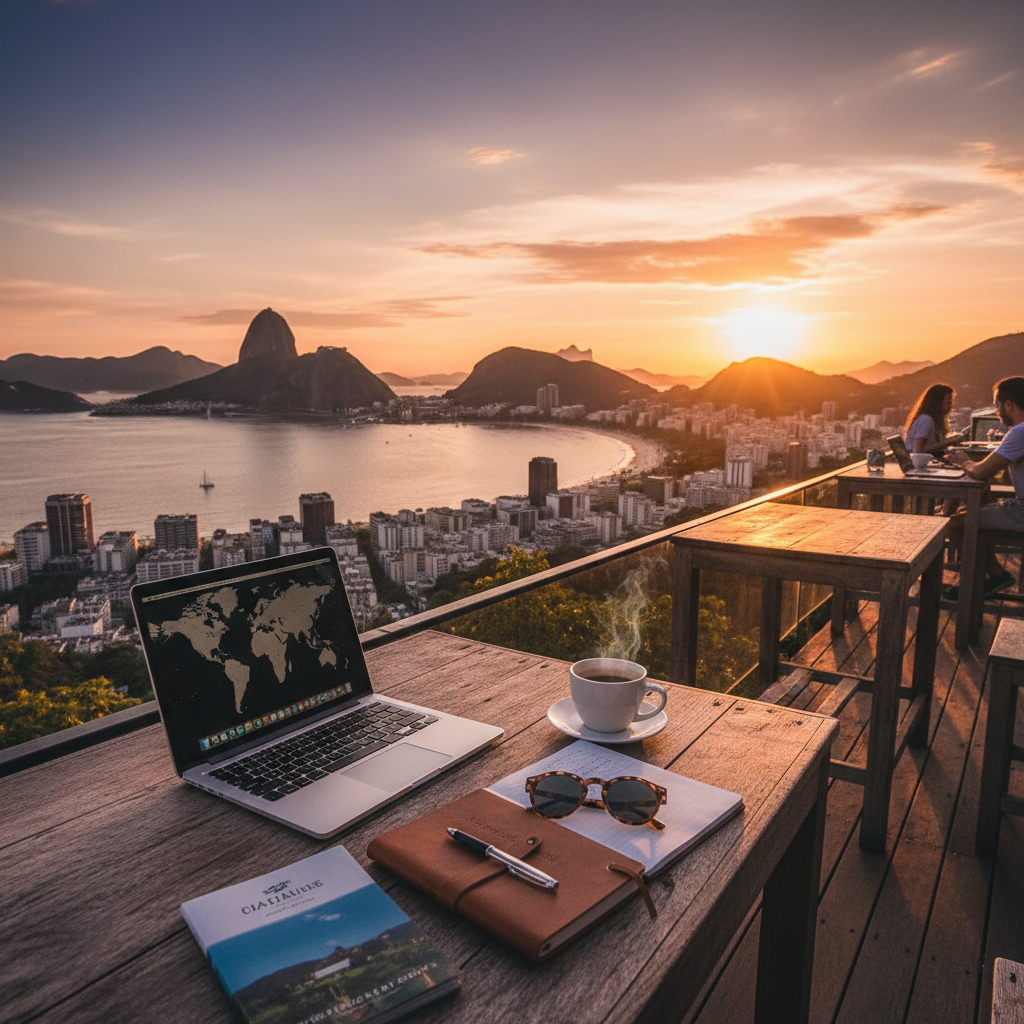
My first 90 days on the Brazil digital nomad visa were a vibrant, often challenging, but ultimately enriching adventure that cemented my belief in the power of working from anywhere.
From the moment I touched down in Rio de Janeiro, Brazil embraced me with its infectious energy, stunning landscapes, and a bureaucratic maze that tested my resolve. Yet, the warmth of its people and the unparalleled cultural experience made every hurdle worth overcoming. This isn't just a travelogue; it's a candid look at the practicalities, the pitfalls, and the triumphs of establishing a temporary home as a digital nomad in one of the world's most captivating countries.
Quick facts
| Row | Detail |
|---|---|
| Income requirement | R$ 10,700 per month (approx. USD 2,000 / EUR 1,850) OR bank balance of R$ 128,400 (approx. USD 24,000 / EUR 22,200) |
| Visa duration | 1 year |
| Renewable | Yes, for an additional year |
| Application fee | Varies by nationality; typically R$ 100 - R$ 300 for processing + R$ 120 consular fee |
| Processing time | Varies significantly; 1-3 months typically |
| Tax rate for holders | Non-resident status for the first 183 days, then potential resident taxation |
| Family members allowed | Yes, dependents can apply |
| Path to residency | No direct path provided by the DNV, but continuous legal stay can eventually lead to permanent residency under other categories |
What is the Brazil digital nomad visa?
The Brazil digital nomad visa, officially known as the Temporary Visa VII (VITEM VII) for digital nomads, was introduced in January 2022. It allows remote workers, freelancers, and digital entrepreneurs to live and work in Brazil for up to one year, with the possibility of renewal. The core idea is to attract professionals who earn income from outside Brazil, contributing to the local economy without competing for local jobs. This visa is a game-changer for those of us who cherish a location-independent lifestyle, offering a legal pathway to experience Brazil beyond standard tourist durations.
My initial attraction to the Brazil digital nomad visa was primarily Rio: the promise of Christ the Redeemer watching over Copacabana, the rhythm of samba, and a vibrant culture. But also, as a digital nomad, the affordability of living in comparison to European hotspots was a significant draw. The visa enables you to legally reside and explore the country, providing peace of mind that a tourist visa simply can't offer. From a professional standpoint, it opened up opportunities to connect with the burgeoning remote work community in cities like São Paulo and Florianópolis.
Brazil digital nomad visa requirements
Before I even thought about packing my bags, I had to ensure I met the stringent requirements for the Brazil digital nomad visa. My journey began by poring over the official immigration website (always consult the country's official immigration website for the most current information) and local embassy guidelines. Here's what they asked for:
- Valid Passport: Your passport must be valid for at least six months beyond your intended stay and have at least two blank pages.
- Proof of Remote Work: This is crucial. You need to demonstrate that you're employed by or provide services to an entity outside of Brazil. For me, this meant a letter from my US-based employer confirming my remote work status and job description. Freelancers would submit contracts with international clients. The key is showing your work is performed for non-Brazilian entities.
- Income Requirement: This was a big one. Applicants must prove a minimum monthly income of at least R$ 10,700, or a bank balance of at least R$ 128,400. I provided six months of bank statements and employer pay stubs. My monthly income comfortably exceeded the R$ 10,700 mark, which translates to approximately USD 2,000 or EUR 1,850 depending on current exchange rates. This ensures you can sustain yourself without burdening the local economy.
- Medical Insurance: Comprehensive health insurance valid in Brazil for your entire stay is mandatory. I opted for an international plan that specifically covered Brazil, ensuring I had adequate medical protection.
- Background Check: A criminal record certificate from my country of residence (and any other country I'd lived in for the past five years) was required. This needed to be apostilled and translated into Portuguese. This step can often be a bottleneck, so prepare it early.
- Visa Application Form: Completing the online form accurately is essential. Double-check every detail.
- Passport-Sized Photo: A recent, clear photograph meeting standard passport photo requirements.
For dependants, the requirements are largely similar, with additional proof of relationship (marriage certificate for spouses, birth certificates for children) and usually proof that the primary applicant's income can support the entire family. Always verify the specific requirements with the Brazilian consulate or embassy in your region, as they can have slight variations.
How to apply for the Brazil digital nomad visa
The application process for the Brazil digital nomad visa is a multi-step journey. I applied from the United States, and the steps might vary slightly depending on your country of residence, but the general outline remains consistent.
- Gather Documentation: This is the most time-consuming part. As listed above, get all your documents in order, translated by a certified translator into Portuguese (if not already in Portuguese or English, though English is often accepted for core documents), and apostilled where necessary. My criminal background check and marriage certificate (for my partner who joined later) definitely needed this.
- Complete the Online Application Form: I filled out the form on the Sistema de Visto Online (e-Consular) portal specific to the Brazilian consulate that served my home address. This form requires detailed personal information, travel plans, and a declaration of intent for your digital nomad activities.
- Upload Documents Electronically: After completing the form, I uploaded all my supporting documents to the e-Consular system. Ensure scans are clear and legible. This preliminary submission allows the consulate to pre-screen your application.
- Schedule an Appointment: Once your documents are pre-approved online, you'll be prompted to schedule an appointment at your nearest Brazilian consulate. Be prepared for potentially long wait times, especially in popular consular districts.
- Attend the Interview/Submission: I attended my appointment with all my original documents and their certified copies. The consular officer reviewed everything, asked a few clarifying questions about my remote work setup, and finally accepted my application. This is where you'll pay the visa processing fee.
- Visa Issuance: After the interview, it's a waiting game. Processing times can vary significantly. For me, it took about two months from my consulate appointment to receiving my passport back with the shiny new VITEM VII visa sticker. Some people report faster times, others longer, so patience is key. The visa itself is valid for one year from the date of issue or entrance into Brazil, depending on the consulate's stamp.
Upon arrival in Brazil, within 90 days you must register with the Polícia Federal (Federal Police). This is a vital step and often surprises nomads. I managed to book my Polícia Federal appointment about six weeks after arriving. This process involves another set of documents (visa, passport, entry stamp, medical insurance, proof of residence in Brazil, and payment of the registration fee – GRU). Once registered, you receive your temporary residency card (Registro Nacional Migratório - RNM), which is your official ID in Brazil. Failure to register can lead to fines and complications, so prioritize this!
Cost breakdown
The financial aspect of securing and living on the Brazil digital nomad visa was a significant part of my initial 90 days. Here’s a breakdown:
- Visa Application Fee: This varies by nationality. For US citizens like myself, the visa processing fee can be around R$ 100 - R$ 300, plus a consular fee of R$ 120. (Total roughly USD 20 - 70). Always check with your local Brazilian consulate for exact fees, as they can fluctuate.
- Document Apostille & Translation: This was a substantial cost. Each document that needed an apostille (e.g., criminal record) cost around USD 40-50. Certified translations into Portuguese averaged USD 30-70 per page. For my criminal record and family documents, this amounted to approximately USD 350.
- Health Insurance: My international health insurance plan covering Brazil cost me about USD 100 per month, or USD 1200 annually. This is non-negotiable and essential.
- Polícia Federal Registration: Upon arrival, the fees for registration and issuing the RNM card summed up to approximately R$ 204.77 (GRU fees: R$ 109.92 for registration and R$ 94.85 for the RNM card), which is roughly USD 40. This is mandatory and separate from the initial visa fee.
- Cost of Living (First 90 Days in Rio):
- Accommodation: I rented a furnished 1-bedroom apartment in Botafogo for R$ 3,500/month (approx. USD 650). This included utilities. Rio can be more expensive, but good deals are available outside prime tourist zones like Ipanema.
- Groceries: Around R$ 800/month (approx. USD 150). Local markets offer great value.
- Transportation: Uber/public transport, R$ 300/month (approx. USD 55). Rio has an extensive and affordable public transport network.
- Eating Out/Nightlife: R$ 1,200/month (approx. USD 220). This varied wildly based on how often I indulged in churrascarias and local botecos.
- Coworking Space: I used a coworking space twice a week for R$ 400/month (approx. USD 75) for better focus and networking.
- Miscellaneous (SIM card, personal care, occasional travel): R$ 500/month (approx. USD 90).
Total estimated initial costs before arriving: Around USD 1,700 (visa, docs, insurance). Total estimated monthly living cost in Rio: Around USD 1,240. So, my initial 90 days involved significant upfront costs, but once settled, monthly expenses were well within my budget.
| Item | Estimated Cost (USD) |
|---|---|
| Visa Application Fees | 20 - 70 |
| Document Apostille/Translation | 350 |
| Annual Health Insurance | 1200 |
| Polícia Federal Registration | 40 |
| Subtotal Upfront Costs | 1610 - 1660 |
| Monthly Accommodation (Rio) | 650 |
| Monthly Groceries | 150 |
| Monthly Transportation | 55 |
| Monthly Eating Out/Nightlife | 220 |
| Monthly Coworking Space | 75 |
| Monthly Miscellaneous | 90 |
| Total Estimated Monthly Living | 1240 |
Note: Exchange rates are approximate as of early 2026 (1 USD ≈ 5.3 BRL, 1 EUR ≈ 5.7 BRL) and can fluctuate.
Taxes for digital nomads in Brazil
This was one of the more complex aspects I had to understand. For the Brazil digital nomad visa holders, the tax situation generally works like this:
- Non-Resident Status (First 183 Days): For the first 183 days of your stay in a 12-month period, you are generally considered a non-resident for tax purposes in Brazil. This means your foreign-sourced income (the income you earn from your remote work for non-Brazilian entities) is not subject to Brazilian income tax. This was a huge advantage for me and a major draw for the visa.
- Resident Status (After 183 Days): If you stay in Brazil for more than 183 days within any 12-month period, you may be considered a tax resident. As a tax resident, your worldwide income (including your foreign-sourced digital nomad income) potentially becomes subject to Brazilian income tax, which can be progressive, reaching up to 27.5%. Double taxation agreements may apply depending on your home country, but this is a critical point to consider for longer stays.
It's absolutely essential to consult with a Brazilian tax advisor or an accountant specializing in international taxation. I engaged one during my second month to clarify my obligations, especially if I decided to renew the visa. They emphasized that while the first 183 days are generally tax-free on foreign income, any income derived from Brazilian sources (e.g., local investments, rental income from a property you might buy) would be taxable from day one. I paid particular attention to not engaging in any work for Brazilian entities to maintain my non-resident tax status for my primary income source.
For Bangladeshi passport holders
For digital nomads from Bangladesh considering the Brazil digital nomad visa, the application process will follow the general guidelines, but with specific consular requirements from the Embassy of Brazil in Dhaka. Bangladeshi citizens will need to pay close attention to the following:
- Consular Jurisdiction: Ensure you apply through the correct Brazilian consulate or embassy that serves Bangladesh. The Embassy in Dhaka will be your point of contact.
- Document Attestation: All documents (e.g., criminal record certificate, educational certificates, marriage certificates) will likely require attestation from the Ministry of Foreign Affairs in Bangladesh before being presented to the Brazilian embassy. Subsequent apostille (or equivalent legalization if Bangladesh is not a party to the Hague Apostille Convention for Brazil) might then be required, followed by certified translation into Portuguese.
- Income Verification: Proving the minimum income requirement of R$ 10,700 per month will involve submitting robust bank statements, salary certificates, and employment contracts or client agreements. For freelancers in Bangladesh, reliable digital payment records and contract documentation are vital.
- Processing Times: While the stated processing times are 1-3 months, be prepared for potential variations. Consular processing can sometimes take longer, so apply well in advance of your intended travel date.
- Cultural Context: While not a visa requirement, understanding the cultural nuances and language (Portuguese) will significantly enhance your experience. Engaging with a local community in Bangladesh that has experience with Brazilian immigration can offer invaluable peer support. For instance, exploring digital nomad Bangladesh groups online might connect you with others who have navigated similar processes.
The cost breakdown provided above is in USD and BRL; Bangladeshi applicants should convert this to BDT for their budgeting purposes, taking into account current exchange rates (e.g., 1 USD ≈ 110 BDT as of early 2026) and local costs of document processing in Bangladesh.
My First 90 Days: Lessons Learned and Unexpected Twists
My initial three months in Brazil were a whirlwind. I started in Rio, soaking up the sun on Copacabana, learning rudimentary Portuguese phrases, and marveling at the vibrant street art in Santa Teresa. The digital nomad lifestyle truly took hold as I balanced my remote work schedule with explorations of Sugarloaf Mountain and the lively Lapa district.
The Language Barrier: This was my biggest challenge. While many people in tourist areas speak some English, outside of these zones, Portuguese is essential. My daily Duolingo lessons became a lifesaver, and I enrolled in a local Portuguese school for a month. It not only helped with practical matters but also opened doors to deeper cultural immersion.
Bureaucracy and Patience: The Polícia Federal registration was a prime example. Booking an appointment online was challenging due to high demand. I had to be persistent, checking the website multiple times a day until a slot opened up. The actual appointment was surprisingly efficient, but the waiting period for the RNM card was nerve-wracking. Always allocate extra time for these processes.
Internet Connectivity: I found internet speeds in major cities like Rio and São Paulo to be excellent, easily supporting video calls for my remote career. However, consistency varied in smaller towns. Always research connectivity if you plan on venturing off the beaten path. I relied on a local SIM card (Claro or Vivo are good options) with a generous data plan for mobile hotspots when needed.
Safety: Like any major city, Rio has its safety concerns. I quickly learned to adopt local habits: not flaunting expensive electronics, being aware of my surroundings, and avoiding certain areas at night. Common sense goes a long way. The digital nomad lifestyle often involves exploring new places; being vigilant is part of the package.
Community: I actively sought out coworking spaces and digital nomad meetups. This was crucial for combating loneliness and building a support network. I found several WhatsApp groups and Facebook communities for remote workers in Rio and São Paulo, which provided invaluable tips on everything from finding laundromats to recommending local restaurants.
Reflecting on these 90 days, the most significant lesson was adaptability. Brazil is a country of incredible contrasts and energy. The Brazil digital nomad visa provided the framework, but my personal journey was defined by how I navigated the unexpected, embraced the new, and allowed myself to be enchanted by the sheer joy of Brazilian life.
The renewal process for the Brazil digital nomad visa generally requires proving you still meet the income requirements and have valid health insurance. It's usually initiated at the Polícia Federal office before your current visa expires. Plan ahead, as administrative processes can take time.
Frequently asked questions
What is the Brazil digital nomad visa? The Brazil digital nomad visa (VITEM VII) allows remote workers to legally reside and work in Brazil for up to one year. It's designed for individuals earning income from companies or clients located outside of Brazil, supporting a location-independent lifestyle.
Who is eligible for the Brazil digital nomad visa? Eligibility requires proof of remote work for a non-Brazilian entity, a minimum monthly income of R$ 10,700 (or R$ 128,400 in savings), valid medical insurance, a clean criminal record, and a valid passport.
How much does the Brazil digital nomad visa cost? Application fees vary by nationality, generally R$ 100-300 plus a R$ 120 consular fee. Expect additional costs for document apostille, certified translations (USD 300-400), and mandatory post-arrival Polícia Federal registration fees of approximately R$ 205.
How long does Brazil digital nomad visa processing take? Processing times can vary significantly, typically ranging from 1 to 3 months from the consulate appointment to visa issuance. Some experiences report faster times if all documents are perfectly in order.
Can I bring my family on the Brazil digital nomad visa? Yes, dependants such as spouses and children can apply for accompanying visas. They will need to provide proof of relationship and the primary applicant must demonstrate sufficient income to support the entire family.
Do I pay tax in Brazil on the digital nomad visa? For the first 183 days of your stay in Brazil within a 12-month period, foreign-sourced income is generally not subject to Brazilian income tax. If you stay longer than 183 days, you may become a tax resident and subject to Brazilian tax on worldwide income.
Can Bangladeshi citizens get the Brazil digital nomad visa? Yes, Bangladeshi citizens are eligible. They will need to apply through the Brazilian Embassy in Dhaka, fulfilling all standard requirements, including specific document attestation from the Bangladeshi Ministry of Foreign Affairs and certified translations.
Sources
- Brazilian Ministry of Foreign Affairs (Itamaraty) – Information on visa types and requirements (consult the country's official immigration website).
- Brazil's Federal Police (Polícia Federal) – Information on migrant registration and residency (consult the country's official immigration website).
- Brazilian Consulates/Embassies worldwide – Specific application procedures and fees for various nationalities (consult the country's official immigration website).
- Brazil tax code and regulations (Legislação Tributária Brasileira) – For detailed tax residency rules (consult the country's official immigration website).
Compare with: Argentina, Colombia, Portugal
Interested in applying for the Brazil visa?
Tell us a bit about yourself and we'll send tailored guidance on eligibility, paperwork, and next steps.