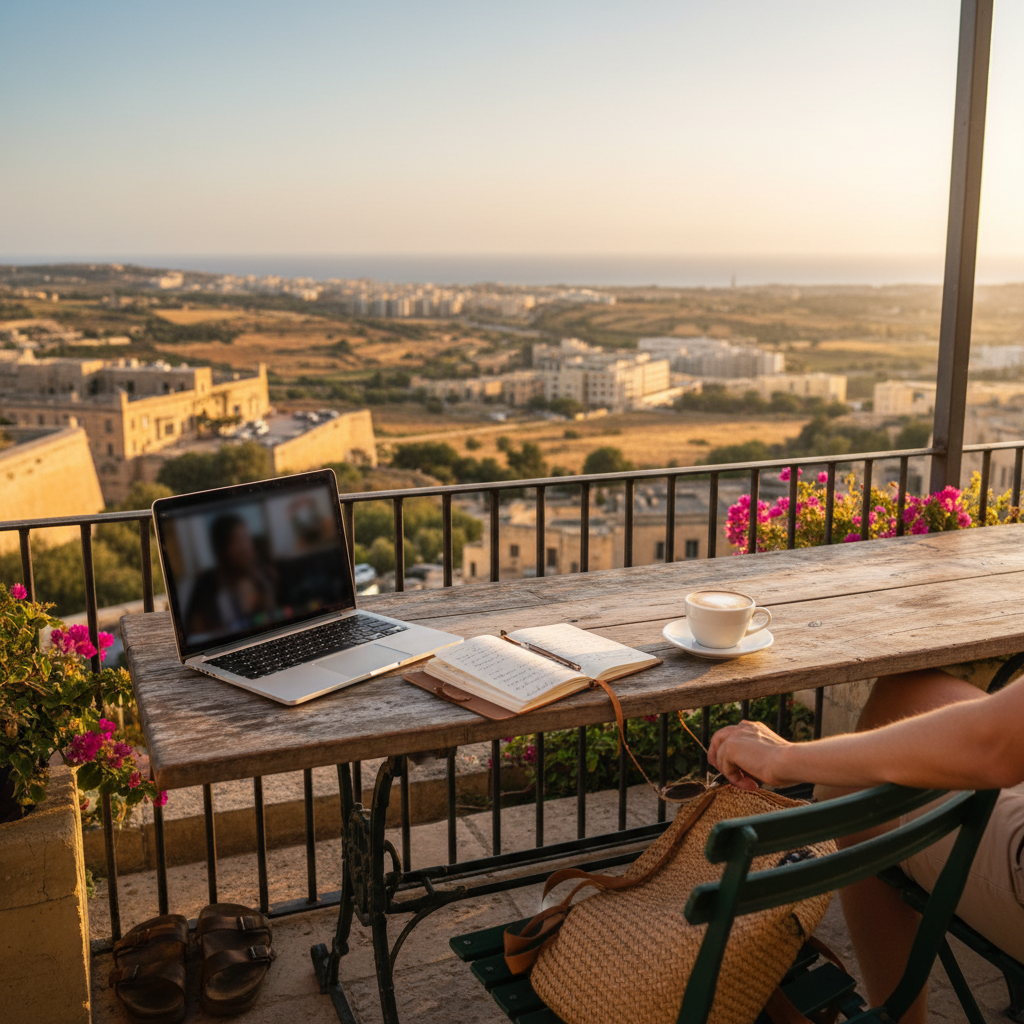
Iceland's Digital Nomad Visa: Unpacking the 2026 Tax & Residency Realities
Debunking the myth of tax-free remote work in Iceland, this guide offers an analytical deep dive into the 2026 digital nomad visa and its intricate tax implications, residency rules, and financial requirements for remote professionals.
May 27, 2026

Iceland's Digital Nomad Visa: Unpacking the 2026 Tax & Residency Realities
Many digital nomads dream of Iceland – its dramatic landscapes, the allure of the Northern Lights, and a culture steeped in folklore. With the introduction of its long-term visa for remote workers, the fantasy of working from a cozy cabin overlooking a volcanic vista became a tangible reality. However, a common misconception often surfaces: that a digital nomad visa automatically grants 'tax-free' status in the host country, especially for periods less than a full tax year. For Iceland, a nation with robust social welfare and a well-structured tax system, nothing could be further from the truth. This deep dive will dissect the 2026 Iceland Digital Nomad Visa, focusing specifically on its intricate tax and residency implications, comparing it with typical home country tax obligations, and navigating the nuances of double taxation treaties.
Working remotely from Iceland is not a tax holiday. While the visa itself allows a stay of up to 180 days (or potentially longer under specific conditions), understanding your tax obligations in both Iceland and your home country is paramount to avoid unpleasant surprises, penalties, and potential issues with your long-term residency plans. This guide will equip you with the analytical tools and concrete figures necessary to plan your Icelandic remote work adventure responsibly.
Eligibility for the Iceland Digital Nomad Visa (2026)
The Icelandic Directorate of Immigration (Útlendingastofnun) introduced this long-term visa primarily for high-income earners who can financially sustain themselves without becoming a burden on the Icelandic social system. To qualify for the 2026 Iceland Digital Nomad Visa, applicants must meet several key criteria:
- Non-EEA/EFTA Citizen: The visa is designed for citizens from countries outside the European Economic Area (EEA) and the European Free Trade Association (EFTA). EEA/EFTA citizens generally have different rights regarding long-term stays.
- Employment Outside Iceland: You must be employed by a company registered outside Iceland or be self-employed with clients primarily located outside Iceland. The core principle is that your work must not compete with the Icelandic job market.
- Sufficient Income: This is a critical financial hurdle. As of 2026, the minimum monthly income requirement is ISK 1,000,000 (approximately EUR 6,850 or USD 7,450, depending on current exchange rates) for an individual applicant. For an accompanying spouse/registered partner, an additional ISK 200,000 (approximately EUR 1,370 or USD 1,490) per month is required, bringing the total to ISK 1,200,000 (EUR 8,220 / USD 8,940) for a couple. This income must be verifiable through bank statements, employment contracts, and tax returns.
- No Prior Icelandic Residency: You must not have been granted a residence permit in Iceland within the last 12 months before your application. This prevents individuals from using the digital nomad visa for continuous, indefinite stays.
- Valid Health Insurance: Comprehensive health insurance valid in Iceland for the duration of your stay is mandatory.
- Clean Criminal Record: A certificate of good conduct or police clearance from your home country is required.
It's crucial to note that the income requirement is a gross monthly income, not net. This means your professional services income or salary before any deductions must meet or exceed these thresholds.
Application Process: A Step-by-Step Guide for 2026
The application process for the Iceland Digital Nomad Visa involves several stages. While typically straightforward, meticulous attention to detail is crucial.
- Gather Documents: Collect all necessary documents, including passport copies, proof of employment/self-employment (contracts, company registration, client agreements), detailed bank statements showing consistent income for the past 3-6 months, health insurance policy, police clearance, and marriage/birth certificates if applying with dependants.
- Complete the Application Form: Download and meticulously fill out the 'Application for a long-term visa for remote workers' form from the Directorate of Immigration's official website.
- Pay the Application Fee: The application fee for the Iceland Digital Nomad Visa is ISK 15,000 (approximately EUR 103 / USD 112). This fee is non-refundable, regardless of the application's outcome. Payment is typically made online during the application submission or via bank transfer, and proof of payment must be included.
- Submit the Application: Applications are generally submitted electronically or via mail to the Directorate of Immigration in Iceland. If you are already in Iceland on a short-stay visa (e.g., Schengen visa), you might be able to submit your application in person, but it's always advisable to verify the current rules. Submitting from outside Iceland is the most common route.
- Await Decision: The Directorate of Immigration will review your application. During this period, they may request additional documents or clarifications.
- Visa Issuance: If approved, you will receive notification, and the visa will either be affixed to your passport or provided as an official document, depending on the submission method and your current location.
Processing Times
As of 2026, the stated processing time for the Iceland Digital Nomad Visa is typically 3-4 weeks from the date a complete application is received. However, this is an estimate and can vary based on caseloads and the complexity of individual cases. It is highly recommended to apply well in advance of your intended travel date, ideally 2-3 months.
Deep Dive into Icelandic Tax and Residency
This is where the analytical focus of this guide truly comes into play. The common misconception of 'tax-free' digital nomad life in Iceland quickly dissolves when confronted with the local tax regulations and international tax treaties.
Short-Term Stay vs. Tax Residency
Iceland's digital nomad visa is typically granted for a period of up to 180 days (6 months). While longer stays might be possible in exceptional circumstances for specific individuals, the standard duration is crucial for tax purposes.
Key Principle: Generally, an individual becomes an Icelandic tax resident if they reside in Iceland for more than 183 days within any 12-month period. However, this is a simplified view and the actual determination of tax residency is complex and governed by both domestic law and double taxation treaties.
If your stay explicitly does not exceed 183 days within a 12-month period, you are generally not considered a tax resident of Iceland. This is the intended scenario for most digital nomads using this visa. In this case, your primary tax obligations for your worldwide income will remain in your home country (your country of tax residence).
Icelandic Source Income and Double Taxation Treaties
Even if you are not an Icelandic tax resident, you could still be liable for taxes on certain income sourced from Iceland. However, the digital nomad visa specifically stipulates that your employment and clients must be outside Iceland. This means that, by definition of the visa, you should not be generating Icelandic source income. If you were, it would likely invalidate your visa conditions.
What about capital gains from Icelandic investments or rental income from Icelandic property? If you engage in such activities during your stay, even as a non-resident, that income could be subject to Icelandic tax laws. This is less common for typical digital nomads but worth noting.
The Role of Double Taxation Treaties (DTTs)
Iceland has an extensive network of double taxation treaties with numerous countries. These treaties are designed to:
- Prevent Double Taxation: Ensure that income is not taxed twice – once in Iceland and once in your home country.
- Determine Tax Residency: Provide tie-breaker rules to determine which country has primary taxing rights if an individual is deemed a resident of both countries under their domestic laws.
- Allocate Taxing Rights: Define which country has the right to tax different types of income (e.g., employment income, business profits, dividends).
For a digital nomad on a 180-day visa, the DTTs are typically less about reducing Icelandic tax and more about confirming that Iceland does not have primary taxing rights over your remote work income. A common clause in DTTs (often Article 15 for 'Income from Employment' or Article 7 for 'Business Profits') states that an individual is typically taxed in their country of residence unless they exercise their employment in the other contracting state for a period exceeding a certain threshold (e.g., 183 days). Since the Icelandic Digital Nomad Visa limits your stay to less than 183 days, your employment income should generally remain taxable only in your home country, provided your employer has no permanent establishment in Iceland.
Example Scenario: An American digital nomad stays in Iceland for 5 months. Under US law, they remain a US tax resident (assuming they don't meet the Physical Presence Test for foreign earned income exclusion elsewhere). Under Icelandic law, they do not meet the 183-day threshold for Icelandic tax residency. The US-Iceland DTT would reinforce that the US retains primary taxing rights over their remote work income. However, the requirement to declare this income in their home country remains absolute.
The Importance of Home Country Tax Residency
It is imperative that you maintain tax residency in your home country (or another country) during your stay in Iceland. Simply leaving your home country does not automatically sever your tax ties. Many countries have their own residency rules (e.g., substantial presence test, domicile, citizenship-based taxation like the US). You must continue to meet your home country's tax obligations, including filing tax returns and paying taxes on your worldwide income.
If you claim to have no tax residency anywhere, you risk being assessed as a tax resident in Iceland retroactively, which could lead to significant penalties.
Comparison Table: Tax & Residency Implications
To further clarify, let's compare the tax and residency implications for a typical digital nomad on the Icelandic visa versus a full Icelandic tax resident.
| Feature/Scenario | Digital Nomad (≤183 days stay) | Icelandic Tax Resident (>183 days stay) | Tax Implications | Double Taxation Treaty Impact (General) |
|---|---|---|---|---|
| Stay Duration | Max 180 days within any 12-month period | More than 183 days within any 12-month period | DN: Generally not an Icelandic tax resident. Taxable on worldwide income in home country. Iceland only taxes Icelandic source income (usually none for DNV holders). | Confirms home country's primary taxing rights over employment income; prevents Iceland from taxing it if no permanent establishment. |
| Primary Tax Burden | Home Country (where you are tax resident) | Iceland (on worldwide income) | DN: Income from remote work taxed in home country. May need to report stay to home country tax authorities. | Resolves conflicts if both countries claim residency; allocates taxing rights. |
| Social Security | Typically covered by home country system or private insurance. No contribution to Icelandic social security. | Mandatory contributions to Icelandic social security system. | DN: No compulsory contributions to Icelandic social security unless employed by an Icelandic entity. | May exempt from contributions in one country if covered in another (depending on bilateral agreements). |
| Access to Public Services | Limited to emergency healthcare via travel insurance. No general access to welfare, unemployment benefits. | Full access to public healthcare, social benefits (subject to eligibility criteria). | DN: Cannot rely on Icelandic public services beyond emergency care covered by insurance. | Not directly tax-related, but impacts overall cost of living and benefits. |
| Tax Filing | No Icelandic tax filing required for remote work income. Must file in home country. | Annual Icelandic tax return (framtal) required. | DN: Simplifies Icelandic compliance; shifts burden to home country. | Provides mechanisms for claiming tax credits if double taxation occurs (unlikely for DNV). |
| Business Registration | Not required in Iceland for remote work. | May be required if self-employed with Icelandic clients/operations. | DN: Avoids complexities of setting up a business entity in Iceland. | Specifies where business profits are taxable. |
Fees and Costs for the Iceland Digital Nomad Visa (2026)
Beyond the application fee, there are other financial considerations to budget for:
- Application Fee: ISK 15,000 (approx. EUR 103 / USD 112).
- Health Insurance: This cost varies significantly based on coverage, age, and provider. Expect to pay anywhere from EUR 50-200 / USD 55-220 per month for comprehensive travel/health insurance that meets the visa requirements. For a 6-month stay, this could easily amount to EUR 300-1,200 / USD 330-1,320.
- Proof of Funds (Income Threshold): While not a fee, you must demonstrate an income of ISK 1,000,000 per month (approx. EUR 6,850 / USD 7,450). This isn't money you pay to the government but rather a requirement for your financial stability.
- Translation Costs: If any of your documents are not in English or Icelandic, certified translations will be required, incurring additional costs (typically EUR 30-70 per document).
- Police Clearance Certificate: Fees vary by country of origin, usually EUR 10-50 / USD 11-55.
- Flights and Accommodation: Iceland is not a cheap country. Budget generously for flights and accommodation, especially in popular areas like Reykjavik. A mid-range apartment can cost upwards of EUR 1,500-2,500 / USD 1,650-2,750 per month, not including utilities.
Family and Dependants Rules
Good news for partners: the Iceland Digital Nomad Visa typically allows for an accompanying spouse or registered partner. However, there are strict conditions:
- Proof of Relationship: You must provide official documentation, such as a marriage certificate or certificate of registered partnership.
- Increased Income Threshold: As mentioned, an additional ISK 200,000 (approx. EUR 1,370 / USD 1,490) per month is required for the accompanying partner, bringing the total to ISK 1,200,000 per month for a couple. This ensures both individuals are financially supported.
- No Other Dependants: The visa generally does not extend to children or other family members. This visa is explicitly for the remote worker and their legally recognized partner. If you have children, you would need to explore alternative, more comprehensive family reunification visas, which are typically tied to long-term employment or residency in Iceland, and likely not applicable to the digital nomad scheme.
Visa Renewals and Extensions
The Iceland Digital Nomad Visa is generally a single-entry, non-renewable visa for a maximum stay of 180 days. Its purpose is to facilitate a temporary, extended stay, not to serve as a pathway to permanent residency or citizenship. The Directorate of Immigration states that you cannot have held a residence permit in Iceland within the last 12 months, effectively creating a 'cooling-off' period. This means successive back-to-back digital nomad visas are not permitted. If you wish to stay longer, you would need to explore other types of residence permits, which typically require local employment or other qualifying criteria not covered by the digital nomad scheme.
Iceland-Specific Pitfalls for Digital Nomads
While the allure of Iceland is undeniable, it's crucial to be aware of potential challenges unique to this destination:
- High Cost of Living: Iceland is consistently ranked among the most expensive countries globally. Groceries, dining out, transportation, and particularly accommodation can be significantly higher than in many other European nations, even with the high income threshold.
- Weather and Isolation: While breathtaking, Icelandic winters are long, dark, and can be challenging for those unaccustomed to them. Outside of Reykjavik, population density is very low, leading to potential feelings of isolation for some.
- Limited Local Networking: The visa strongly discourages local employment or engagement in the Icelandic job market. This can limit opportunities for professional networking within Iceland if that's a goal for you.
- Internet Connectivity Outside Main Hubs: While major towns have excellent internet, venturing into more remote areas might mean less reliable or slower connections, which could be problematic for remote work.
- Language Barrier (Minor): While most Icelanders speak excellent English, official documents and some local interactions might require Icelandic. Learning basic Icelandic phrases can enhance the experience, but English proficiency is generally sufficient for daily life.
- Tax Misinformation: As discussed, assuming no tax liability in Iceland is a significant pitfall. Always consult with a qualified tax advisor in your home country and, if necessary, an Icelandic tax specialist, especially if your situation is complex or you plan to engage in any income-generating activity within Iceland. The Icelandic Directorate of Internal Revenue (Skatturinn) is the official body for tax matters.
Conclusion: A Responsible Approach to Remote Work in Iceland
Iceland offers an unparalleled backdrop for remote work, but it demands a responsible and well-informed approach, particularly concerning tax and residency. The 2026 Digital Nomad Visa is specifically tailored for high-income, non-EEA/EFTA individuals who can sustain themselves independently and integrate into the local community without competing for jobs or burdening social services. By understanding the strict income requirements, the non-renewable nature of the visa, and crucially, the tax obligations that largely remain with your home country, you can navigate your Icelandic adventure with confidence and compliance.
Do not view this visa as a shortcut to tax evasion or a permanent relocation strategy. Instead, see it as a unique opportunity for an extended immersion in one of the world's most stunning and distinctive countries, built on mutual respect for its laws and economic framework. Plan meticulously, budget wisely, and consult experts for tax advice to ensure your Icelandic digital nomad experience is as smooth and magical as the Northern Lights themselves.
Frequently Asked Questions (FAQ)
Q1: Will I become an Icelandic tax resident on the Digital Nomad Visa?
No, generally not. The Iceland Digital Nomad Visa is typically issued for a maximum of 180 days. According to Icelandic tax law, you generally become a tax resident if you reside in Iceland for more than 183 days within any 12-month period. Since the visa duration is typically less than this, you are usually considered a non-tax resident and your worldwide income remains taxable in your home country.
Q2: Do I need to pay Icelandic taxes on my remote work income?
Assuming you are not an Icelandic tax resident (i.e., you stay for less than 183 days) and your employment or self-employment is based outside Iceland with no Icelandic clients or operations, you will generally not pay Icelandic taxes on your remote work income. However, you remain fully liable for taxes in your country of tax residency.
Q3: What is the exact income requirement for the Iceland Digital Nomad Visa in 2026?
As of 2026, the minimum gross monthly income requirement is ISK 1,000,000 for a single applicant. For an accompanying spouse or registered partner, an additional ISK 200,000 per month is required, bringing the total to ISK 1,200,000 for a couple. This income must be consistently demonstrated over several months prior to application.
Q4: Can I bring my children or other family members with me on this visa?
No, the Iceland Digital Nomad Visa is very specific. It generally only allows for an accompanying spouse or legally registered partner. It does not extend to children or other dependants. If you have children, you would need to explore other types of long-term residence permits, which have different criteria.
Q5: Is the Iceland Digital Nomad Visa renewable or a path to permanent residency?
No, the Iceland Digital Nomad Visa is typically a one-time visa for a maximum of 180 days and is not directly renewable. Furthermore, it is not considered a pathway to permanent residency or citizenship in Iceland. You cannot have held an Icelandic residence permit within the last 12 months to qualify, implying a 'cooling-off' period before you could potentially apply again for a new visa, which is not guaranteed.
Sources
- The Directorate of Immigration (Útlendingastofnun): Consult the country's official immigration website for the most current regulations, application forms, and fees pertaining to the Long-Term Visa for Remote Workers. This is the primary governmental authority.
- Directorate of Internal Revenue (Skatturinn): For detailed information on Icelandic tax laws, residency rules, and double taxation treaties, refer to Skatturinn's official website. This acts as Iceland’s tax authority.
- OECD Model Tax Convention on Income and on Capital: This international framework heavily influences double taxation treaties and provides general principles for taxation of employment and business profits across borders.
- Statistics Iceland (Hagstofa Íslands): For up-to-date data on cost of living, inflation, and economic indicators that might influence the income threshold and living expenses.
- Official Bilateral Double Taxation Treaties: Always consult the specific Double Taxation Treaty between Iceland and your country of tax residence. These documents define the precise tax allocations.
Interested in applying for the Iceland visa?
Tell us a bit about yourself and we'll send tailored guidance on eligibility, paperwork, and next steps.