Raising Global Citizens: The Ultimate Guide to Family-Friendly Digital Nomad Havens in 2026
Considering a location-independent lifestyle with your children? Discover the top family-friendly digital nomad destinations in 2026, offering safety, excellent education, vibrant communities, and a high quality of life for remote working families. We break down costs, visa options, and real-world considerations.
September 19, 2026
Raising Global Citizens: The Ultimate Guide to Family-Friendly Digital Nomad Havens in 2026
The dream of a digital nomad lifestyle often conjures images of solo adventurers, laptops open on a beach in Thailand, or sipping espresso in a bustling European cafe. But what if your vision includes tiny hands exploring ancient ruins, children learning a new language in a vibrant international school, or family movie nights in a cozy Airbnb halfway across the world? The work from anywhere revolution isn't just for singles or childless couples; it's increasingly becoming a powerful path for families seeking a different kind of life, one rich in experiences and cultural immersion.
Moving your family across borders for a location independent lifestyle is a monumental decision, fraught with more considerations than going solo. Safety, educational opportunities, healthcare access, community integration, and, crucially, a welcoming visa framework become paramount. In 2026, several destinations have truly distinguished themselves as havens for remote working families, offering the infrastructure, support, and quality of life necessary to thrive. This guide will navigate you through the best family-friendly digital nomad destinations, helping you turn that global family dream into a tangible reality.
Why Embrace a Family Digital Nomad Lifestyle?
The appeal of a nomadic life with children extends beyond simply changing your postal code. For many, it's about curating an upbringing rich in diversity, adaptability, and first-hand learning. Imagine your child's history lessons coming alive amidst Roman ruins in Portugal, their geography skills honed by navigating new cities, or their linguistic abilities blossoming in a foreign-language immersion setting. It fosters resilience, broadens perspectives, and cultivates a profound appreciation for different cultures.
Furthermore, the flexibility of remote work allows parents to be more present in their children's lives, often escaping the rigid 9-to-5 grind and its associated stresses. It's an investment in family bonding, shared adventures, and creating a lifetime of unconventional memories.
Key Considerations for Family-Friendly Digital Nomad Destinations
Before diving into specific locations, let's outline the critical factors that differentiate a good digital nomad destination from an excellent one for families:
- Safety & Security: This tops the list. Low crime rates, political stability, and a sense of general well-being are non-negotiable.
- Education: Access to quality international schools, local public schools, or robust homeschooling resources is vital. Consider curriculum, cost, and language of instruction.
- Healthcare: Reliable and accessible medical facilities, including pediatric care, are essential. Understand insurance requirements and local healthcare standards.
- Cost of Living: Budgeting for an entire family means every penny counts. Factor in housing, food, transportation, education, and leisure activities.
- Community & Activities: Opportunities for children to socialize, playgrounds, family-friendly attractions, and expat communities are crucial for integration and happiness.
- Visa Accessibility: A clear, family-inclusive visa pathway is indispensable. Many countries now offer digital nomad visas that explicitly allow dependents.
- Connectivity & Infrastructure: Stable internet, reliable utilities, and efficient public transport remain fundamental for digital entrepreneurship and daily life.
Top Family-Friendly Digital Nomad Havens in 2026
Based on these criteria, several countries consistently rise to the top for families seeking a location independent lifestyle.
Portugal: The Golden Standard for Global Families
Portugal continues its reign as a premier destination for digital nomads, and for good reason, especially for families. Its D7 Visa (now evolving into the Digital Nomad Visa) has historically been highly accommodating to dependents, and the country boasts a warm climate, rich history, delicious food, and a relatively affordable cost of living compared to other Western European nations.
Why Portugal for Families?
- Safety: Exceptionally safe with low crime rates.
- Education: Excellent international schools, particularly around Lisbon, Porto, and the Algarve, offering various curricula (IB, British, American). Public schools are also an option for immersion.
- Healthcare: Public healthcare is good, though many expats opt for private insurance for faster access.
- Community: Large, well-established expat communities, especially in Lisbon, Porto, and Cascais, making it easier for families to connect.
- Activities: Abundance of beaches, parks, historical sites, and family-focused events.
- Visa: The Portuguese Digital Nomad Visa (visa for exercising professional activity remotely) explicitly covers family reunification, allowing spouses/partners and dependent children.
Quick Facts for Portugal's Digital Nomad Visa (2026)
| Feature | Details |
|---|---|
| Income requirement | €3,280/month (4x national minimum wage for main applicant, plus 50% for spouse, 30% per child) |
| Visa duration | Initial 1-year residency permit, renewable for 2+2 years. Path to permanent residency after 5 years. |
| Renewable | Yes, up to 5 years total, then possible PR. |
| Application fee | Visa application: ~€90. Residence permit: ~€160 (main applicant), ~€80 (spouse), ~€50 (child). |
| Processing time | 60-90 days for visa; residence permit appointment can take longer. |
| Tax rate for holders | Non-habitual Resident (NHR) status offers 20% flat income tax for 10 years (if eligible). Standard rates apply otherwise. |
| Family members allowed | Spouses/partners, dependent children under 18 (or under 26 if full-time students and financially dependent). |
| Path to residency | Yes, after 5 years of legal residency. |
Spain: Culture, Climate, and Connectivity
Spain's Digital Nomad Visa, launched in 2023, quickly positioned it as another top contender for families. It combines a vibrant culture with a Mediterranean climate and significantly improved digital infrastructure. Cities like Valencia, Malaga, and Seville offer a high quality of life at a more accessible price point than Madrid or Barcelona.
Why Spain for Families?
- Safety: Generally very safe, particularly in major cities and tourist areas.
- Education: Robust public and private international school options, especially in coastal areas and larger cities. Learning Spanish is an enriching experience for children.
- Healthcare: Excellent public healthcare system. Many expats opt for private insurance for additional flexibility.
- Community: Thriving expat communities in popular regions. Spanish culture is highly family-oriented, with children often included in social activities.
- Activities: Endless historical sites, beaches, parks, and cultural festivals. Affordable and efficient public transport.
- Visa: The Spanish Digital Nomad Visa explicitly includes family members, covering spouses, registered partners, and dependent children. It's a relatively straightforward process for dependents.
Key Metrics for Spain's Digital Nomad Visa (2026)
| Feature | Details |
|---|---|
| Income requirement | €2,646/month (200% of minimum wage for main applicant, plus 75% for spouse, 25% per child). |
| Visa duration | Initial 1-year visa, convertible to a 3-year residence permit, renewable for 2 years. Path to PR after 5 years. |
| Renewable | Yes, up to 5 years total, then possible PR. |
| Application fee | Visa application: ~€80. Residence permit: ~€120. |
| Processing time | Visa application: ~15-20 days. Residence permit: up to 20 business days from application. |
| Tax rate for holders | Special tax regime (Beckham Law) allows 24% flat tax on Spanish income for first 5 years (if eligible). |
| Family members allowed | Spouses/partners, dependent children under 18 (or under 25 if full-time students). |
| Path to residency | Yes, after 5 years of legal residency. |
Croatia: Adriatic Adventures Await
Croatia, with its stunning coastline, ancient cities, and relaxed pace of life, has quickly become a favorite for families. Its digital nomad permit, while not a direct visa, allows for temporary stay without tax obligations on foreign income for up to a year, making it attractive for shorter-term family adventures or testing the waters.
Why Croatia for Families?
- Safety: Very safe with low crime rates, even in tourist areas.
- Education: International schools are available in major cities like Zagreb and Split. Public schools are an option for those planning longer stays and language immersion.
- Healthcare: Public healthcare is available, but private insurance is recommended for expats. Medical facilities are generally good in urban centers.
- Community: Growing expat communities, especially in Split, Dubrovnik, and Zagreb. Children can easily find outdoor activities and other kids.
- Activities: Beautiful national parks, countless islands, clean beaches, and a rich historical heritage provide endless family exploration.
- Visa: The Digital Nomad Permit allows for family members (spouses, partners, and dependent children) to join the main applicant, applying concurrently or subsequently.
Croatia Digital Nomad Permit at a Glance (2026)
| Feature | Details |
|---|---|
| Income requirement | €2,850/month (2.5x average gross salary for main applicant). Additional 10% per family member. |
| Visa duration | Up to 1 year, non-renewable for 6 months after expiry. (Must leave for 90 days before reapplying). |
| Renewable | Not directly renewable; a 90-day hiatus outside Croatia is required before a new application. |
| Application fee | Visa/Permit: €60-€100 (varies by consulate/police station), plus administrative fees. |
| Processing time | 2-4 weeks. |
| Tax rate for holders | 0% tax on foreign-sourced income if conditions are met (not a Croatian tax resident). |
| Family members allowed | Spouses/partners, dependent children under 18 (or older if financially dependent). |
| Path to residency | No direct path to permanent residency through this permit; it's a temporary stay. |
Mauritius: Island Life with a Purpose
Often overlooked, Mauritius offers a compelling proposition for families seeking a tropical, yet sophisticated, digital nomad lifestyle. Its Premium Travel Visa is not technically a digital nomad visa but allows remote workers to stay for a year, with a strong focus on attracting high-net-worth individuals and families. The island boasts political stability, excellent infrastructure, and a multicultural environment.
Why Mauritius for Families?
- Safety: One of Africa's safest countries, with a low crime rate.
- Education: Several reputable international schools, primarily British or French curricula, providing high-quality education.
- Healthcare: Good private healthcare facilities. Private health insurance is essential.
- Community: Welcoming local population and a growing expat community. Family-friendly resorts and activities are abundant.
- Activities: Pristine beaches, water sports, nature reserves, and a vibrant cultural mix. A unique blend of African, Indian, and European influences.
- Visa: The Premium Travel Visa includes family members (spouses and dependent children). The process is generally efficient and straightforward.
Mauritius Premium Travel Visa Snapshot (2026)
| Feature | Details |
|---|---|
| Income requirement | Minimum of $1,500/month for the main applicant, plus an additional $500/month per dependent. |
| Visa duration | Up to 1 year, renewable. |
| Renewable | Yes, as long as conditions are met. |
| Application fee | Free of charge. |
| Processing time | Within 48 hours for online applications. |
| Tax rate for holders | Foreign-sourced income is not taxed in Mauritius. Only local income, if any, is taxed. |
| Family members allowed | Spouses/partners, dependent children under 24 years old. |
| Path to residency | No direct path, but investment schemes can lead to residency. |
A Real-World Family Case Study: The Chengs in Valencia
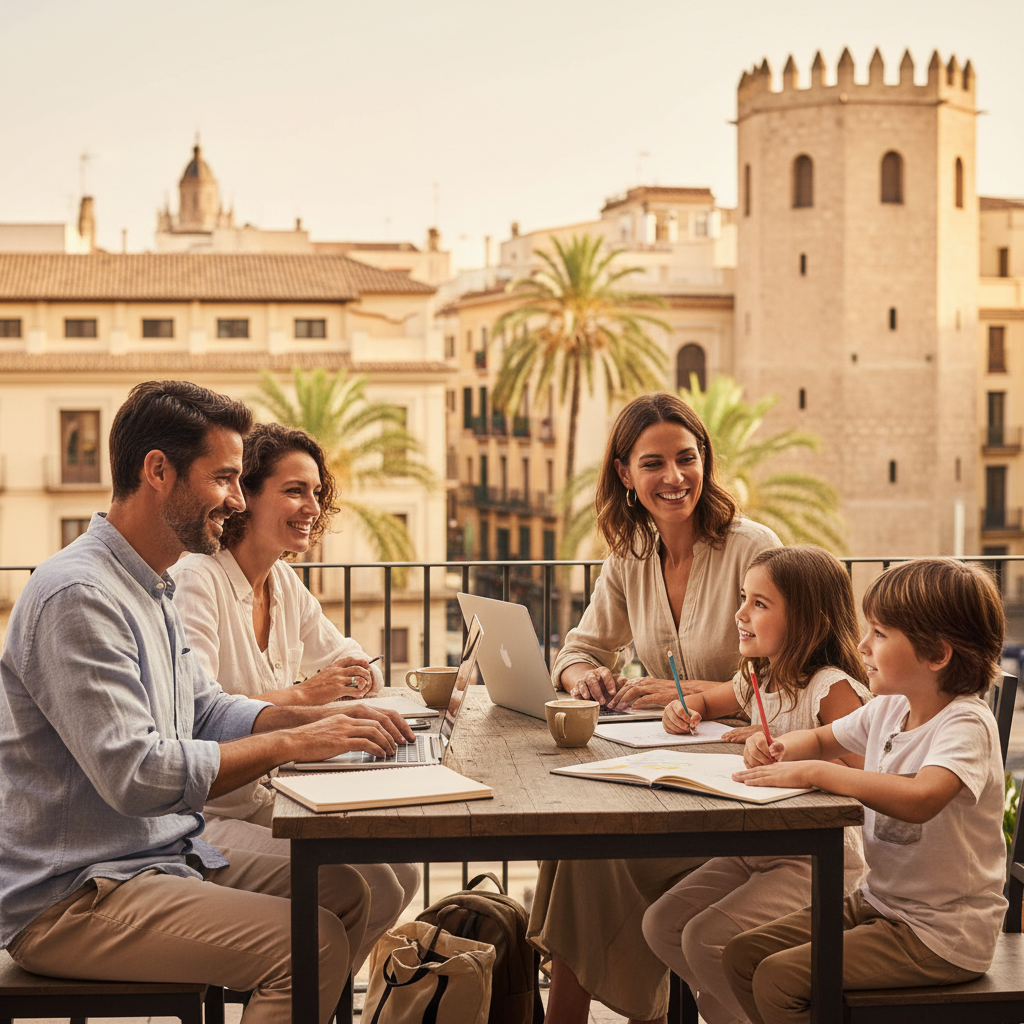
Meet the Cheng family – David (42, a software engineer), Sarah (40, a freelance graphic designer), and their two children, Lily (9) and Noah (7). After years of the demanding pace of city life in Toronto, Canada, they decided to explore a digital nomad lifestyle. Their primary concerns were safety, quality education for the children, and finding a place where they could genuinely connect with a new culture.
They chose Valencia, Spain, for its combination of urban amenities, proximity to the beach, and the slower, family-centric Spanish pace of life. They applied for the Spanish Digital Nomad Visa in early 2024, listing both children as dependents. David's income from his remote tech job easily met the family's financial threshold.
Upon arrival, they enrolled Lily and Noah in an international school offering the British curriculum, where the children quickly adapted, making friends from around the globe. Sarah found a vibrant coworking space in the city center, connecting with other remote career professionals. The family's weekends are now filled with bike rides through the Turia Gardens, paella on the beach, and exploring the historic Old Town. The children are picking up Spanish rapidly, a skill their parents believe will be invaluable.
Their initial costs included: Spanish visa application fees (€80 per person), private health insurance (€150/month for the family), and the first month's rent and security deposit for their 3-bedroom apartment (~€2,000 + €2,000). Their monthly living expenses, including school fees (€800/child), groceries, utilities, and leisure, average around €4,000-€4,500, significantly less than their Toronto expenses, despite the school fees.
Interested in applying?
Tell us a bit about yourself and we'll send tailored guidance on eligibility, paperwork, and next steps.