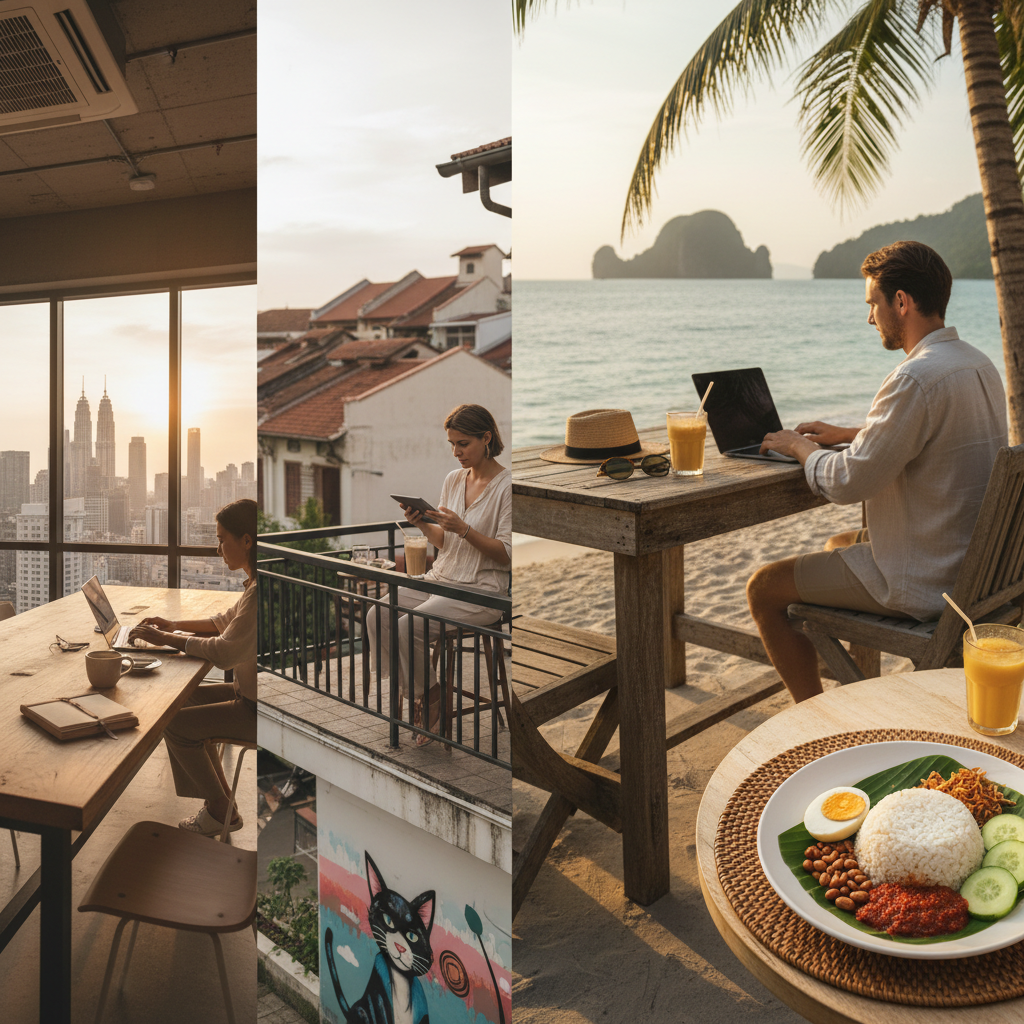
Why Malaysia for Digital Nomads
Malaysia, a dazzling jewel in Southeast Asia, has rapidly emerged as a top contender for digital nomads in 2026. Its compelling blend of vibrant culture, stunning natural beauty, modern infrastructure, and an incredibly affordable cost of living creates an irresistible proposition. From the bustling metropolis of Kuala Lumpur to the serene beaches of Langkawi and the historical charm of Penang, Malaysia offers a diverse range of environments to suit every preference. The government's proactive efforts, particularly with the introduction of the DE Rantau Nomad Pass, signal a clear commitment to attracting and supporting the remote work community. English is widely spoken, especially in urban centers, making integration seamless for many. The country boasts excellent internet connectivity, a thriving food scene catering to all budgets, and a strategic location that serves as a perfect base for exploring the rest of Asia. Imagine working from a contemporary coworking space overlooking the Petronas Towers in the morning and by evening, enjoying world-class street food, or embarking on a jungle trek on the weekend. This is the reality Malaysia offers. The warm, multicultural populace, combined with political stability and a relatively low crime rate, ensures a comfortable and secure environment for long-term stays. Moreover, the ease of access to quality healthcare, efficient public transport in major cities, and the abundance of recreational activities, from diving and hiking to shopping and cultural festivals, further solidify Malaysia's appeal as a premier destination for digital nomads seeking adventure and opportunity.
Visa Options & Eligibility
Malaysia has embraced the digital nomad movement by introducing a dedicated visa: the DE Rantau Nomad Pass. This initiative, launched under the Malaysia Digital Economy Corporation (MDEC), is specifically designed to attract global digital talents and enhance the local digital ecosystem. As of 2026, it remains the primary and most straightforward pathway for remote workers to legally reside and work from Malaysia.
DE Rantau Nomad Pass (for Digital Nomads)
- Eligibility Criteria:
- Occupation: Must be a digital professional, freelancer, or remote worker in industries such as IT (software developers, cybersecurity, AI, blockchain), digital marketing, content creation, UI/UX design, or other digitally-enabled work that can be performed remotely.
- Income Requirement: Applicants must demonstrate a minimum annual gross income of RM 100,000 (approximately $24,000 USD as of early 2026), which translates to roughly $2,000 USD per month. This must be proven through bank statements, contracts, or tax returns.
- Client Base: Must have clients primarily outside of Malaysia. If local clients exist, they should not form the majority of the applicant's income.
- Contract/Employment: Proof of active employment or contracts with foreign-based companies for at least 3 months, or an active portofolio for freelancers.
- Accompanying Dependents: Spouses and children (under 18) are permitted to accompany the main applicant, subject to additional fees and documentation.
- Duration: The initial pass is valid for 12 months and is renewable for another 12 months, allowing for a total stay of up to two years.
- Application Fee (2026): RM 1,000 (approximately $224 USD) for the main applicant, and RM 500 (approximately $112 USD) for each dependent. This is a processing fee and is non-refundable.
- Key Benefit: This pass specifically legalizes your stay and allows you to conduct remote work without needing a traditional work permit, which is often tied to a local employer. It also exempts you from income tax on foreign-sourced income (see 'Taxes & Legal Considerations').
Other Visa Options (Less Suitable for DNs): While other visas exist (e.g., tourist visas, business visit visas), they are not suitable for prolonged remote work. Tourist visas typically restrict work and have shorter stay limits (e.g., 30-90 days), requiring frequent visa runs and carrying the risk of overstaying or violating visa terms. The DE Rantau Nomad Pass is the recommended and designated pathway for digital nomads.
Cost of Living Breakdown
Malaysia offers an exceptionally high quality of life at a fraction of the cost found in Western countries, making it highly attractive for digital nomads. While Kuala Lumpur is the most expensive city, prices remain very reasonable compared to global alternatives. Here's an estimated monthly breakdown for a comfortable single digital nomad in early 2026, assuming mid-range choices.
| Category | Low End (USD) | Mid Range (USD) | High End (USD) |
|---|---|---|---|
| Accommodation | |||
| 1-bedroom apartment (city center) | $350 | $600 | $900 |
| Utilities (Electricity, Water, Internet, Gas) | $50 | $80 | $120 |
| Internet (Fiber, 100-300 Mbps) | Included in utilities | Included in utilities | Included in utilities |
| Food (Groceries & Eating Out) | $250 | $400 | $700 |
| Transportation (Public & Ride-Share) | $30 | $70 | $150 |
| Coworking Space (Hot desk) | $100 | $150 | $250 |
| Health Insurance | $50 | $100 | $200 |
| Miscellaneous (Leisure, shopping, etc.) | $100 | $200 | $400 |
| Total Estimated Monthly Cost | $930 | $1,600 | $2,720 |
- Accommodation: A modern 1-bedroom apartment in a good neighborhood in Kuala Lumpur or Penang, complete with amenities like a pool and gym, can be rented for $500-$800 USD. Outside of city centers or in smaller cities like Ipoh, prices can drop to $300-$450 USD. Airbnb is a good option for short-term, but local rental platforms (e.g., iProperty.com.my, PropertyGuru.com.my) are better for longer stays, often requiring a 2-month deposit.
- Food: This is where Malaysia truly shines. Hawker centers and local restaurants offer delicious meals for as little as $2-5 USD. A good meal in a mid-range restaurant might cost $10-20 USD. Groceries are also inexpensive, especially for local produce.
- Transportation: In Kuala Lumpur, the LRT and MRT systems are efficient and affordable. Ride-sharing apps like Grab are ubiquitous and very cheap ($3-10 USD for most city trips). In Penang, buses are common, and Grab is also prevalent.
- Internet: High-speed fiber optic internet (100Mbps-1Gbps) is widely available and affordable, often included in rental packages or costing around $25-50 USD/month for a standalone plan.
- Healthcare: Public healthcare is very affordable for residents, but digital nomads typically rely on private clinics and hospitals. Prices are significantly lower than in many Western countries, but travel insurance with good coverage is essential.
Overall, a single digital nomad can live comfortably in Malaysia for an average of $800- $1,500 USD per month depending on their lifestyle choices, with $800 USD being a very frugal estimate and $1,500 USD allowing for more luxuries.
Best Cities & Neighborhoods
Malaysia offers a diverse range of environments for digital nomads, from bustling urban centers to laid-back islands.
-
Kuala Lumpur (KL):
- Vibe: A dynamic, multicultural metropolis with dazzling skyscrapers, extensive shopping malls, and a vibrant nightlife.
- Pros: Best infrastructure, widest selection of coworking spaces, excellent public transport, diverse international dining, robust expat community, and numerous networking opportunities.
- Cons: Can be hot and humid, traffic congestion, higher cost of living compared to other Malaysian cities.
- Best Neighborhoods:
- KLCC / Bukit Bintang: Central, premium, close to Petronas Towers, major malls, and entertainment. Higher rent prices.
- Bangsar: Upscale residential area popular with expats, trendy cafes, bars, and a relaxed vibe. Good connectivity.
- Mont Kiara / Desa ParkCity: Surburban, family-friendly areas with international schools and a more community feel, but further from the city center.
- Brickfields (Little India): Culturally rich, affordable food, good transport links, slightly more local feel.
-
Penang (George Town):
- Vibe: A UNESCO World Heritage site known for its colonial architecture, incredible street art, and legendary food scene.
- Pros: Rich cultural heritage, world-renowned street food, relaxed island pace, strong sense of community, significantly cheaper than KL.
- Cons: Fewer coworking spaces than KL, public transport is less comprehensive (reliance on Grab/Taxis), slower pace might not suit everyone.
- Best Neighborhoods:
- George Town (Inner City): Heart of the action, historical charm, walkable, close to cafes and cultural sites.
- Batu Ferringhi: Beachfront area with resorts and more relaxed atmosphere, further from the city center but offers sea views.
- Tanjung Bungah / Tanjung Tokong: Popular residential areas with expats, good access to amenities and less dense than the city center.
-
Johor Bahru (JB):
- Vibe: Gateway city to Singapore, undergoing rapid development, offering a blend of modern amenities and local charm.
- Pros: Extremely affordable, direct access to Singapore (a major advantage for some), growing infrastructure, good for those wanting to explore both countries.
- Cons: Less developed digital nomad infrastructure, can feel less vibrant than KL/Penang, perception of being primarily a transit hub.
- Best Neighborhoods:
- Johor Bahru City Centre: New developments, shopping malls, and connectivity to Singapore.
- Danga Bay: Waterfront area with residential towers and recreational facilities.
-
Langkawi:
- Vibe: A beautiful archipelago with pristine beaches, lush rainforests, and duty-free status.
- Pros: Stunning natural beauty, relaxed island life, duty-free shopping, perfect for nature lovers and those seeking tranquility. Good internet connection available.
- Cons: Limited coworking spaces, fewer urban amenities, less diverse food scene, requires a different working style and a car for mobility.
- Best Neighborhoods:
- Pantai Cenang: Main tourist hub, most amenities, restaurants, and active beachfront.
- Kuah: The main town, more local, shops, and government offices.
-
Kota Kinabalu (KK), Sabah:
- Vibe: The capital of Sabah, Malaysian Borneo, serving as a gateway to Mount Kinabalu, pristine islands, and diverse wildlife.
- Pros: Access to incredible nature, diving, hiking, unique cultural experiences, laid-back atmosphere, growing expat community, access to an international airport.
- Cons: Fewer dedicated coworking spaces, a smaller city feel compared to KL, less developed public transport.
- Best Neighborhoods:
- City Centre: Close to markets, eateries, and waterfront, with modern residential options emerging.
- Tanjung Aru: Famous for its beach views and sunset, residential and resort area.
Internet, Coworking & Remote-Work Infrastructure
Malaysia boasts a robust and continually improving digital infrastructure, making it an excellent base for digital nomads.
-
Internet Connectivity:
- Average Speed (2026): Malaysia's fixed broadband speeds are impressive, averaging around 110 Mbps download and 60 Mbps upload. This is more than sufficient for most remote work activities, including video conferencing, large file transfers, and streaming.
- Fiber Optic: High-speed fiber optic internet (e.g., UniFi, Maxis Fibre, Time Internet) is widely available in urban and suburban areas, offering speeds from 100 Mbps up to 1 Gbps at competitive prices (typically $25-50 USD/month for home plans).
- Mobile Data: 4G LTE coverage is extensive, and 5G networks are rapidly expanding in major cities. Prepaid SIM cards are affordable and easy to acquire (e.g., Celcom, Maxis, Digi, U Mobile), offering generous data packages. An average 30GB data plan costs around $10-20 USD.
- Reliability: While occasional outages can occur, overall internet reliability is high in major cities.
-
Coworking Spaces:
- Kuala Lumpur: The undisputed hub for coworking, KL offers a vast array of options, from global chains to independent local spaces. Popular choices include WeWork, Regus, Common Ground (a homegrown Malaysian success story), WORQ, and Co-labs Coworking. Prices for a hot desk typically range from $100-250 USD/month, offering amenities like high-speed internet, meeting rooms, printing, and community events.
- Penang: George Town and its surrounding areas have a growing number of coworking spaces, though fewer than KL. Options like Found8 (formerly Common Ground), @CAT, and The Venture are popular. Prices are often slightly lower than in KL.
- Johor Bahru: With its proximity to Singapore, JB also has several coworking options, albeit on a smaller scale, such as The Work Project and Infinity8 Reserve.
- Other Cities: While dedicated coworking spaces might be less common in places like Langkawi or Kota Kinabalu, many cafes offer strong Wi-Fi and a conducive environment for working remotely.
-
Remote-Work Infrastructure & Technology:
- Tech Stores: Electronics and computer stores are plentiful in major cities (e.g., Low Yat Plaza in KL is a tech haven), offering competitive prices on gadgets, accessories, and repairs.
- Payment Systems: Cash is still common, but cashless payments (credit/debit cards, Touch 'n Go e-wallet, GrabPay) are widely accepted, especially in urban areas.
- Power Supply: Malaysia uses Type G power outlets (three-pin square) with a voltage of 240V and a frequency of 50Hz. Adapters are cheap and widely available.
Taxes & Legal Considerations
Navigating taxes and legalities is crucial for any digital nomad. The DE Rantau Nomad Pass simplifies some aspects, particularly regarding income tax.
-
Income Tax:
- Foreign-Sourced Income: A significant advantage of the DE Rantau Nomad Pass is that holders are not subject to Malaysian income tax on income earned from foreign sources. This means if your clients or employer are outside Malaysia, and you generate income from them, you will generally not pay Malaysian taxes on that income. This is a powerful incentive.
- Malaysian-Sourced Income: If, however, you engage in any work for Malaysian-based clients or companies, that income would be considered Malaysian-sourced and therefore subject to Malaysian income tax. It's crucial to understand this distinction. Tax rates in Malaysia are progressive, ranging from 0% to 30% for individuals, depending on income brackets.
- Tax Residency: While the DE Rantau pass allows for a stay of up to two years, general Malaysian tax residency rules typically consider an individual a tax resident if they reside in the country for more than 182 days in a calendar year. However, the DE Rantau's specific conditions regarding foreign-sourced income generally supersede this for approved nomads. It is always wise to seek professional tax advice if you have complex income streams or intend to stay long-term.
-
Social Security & Healthcare:
- Digital nomads on the DE Rantau pass are typically not enrolled in Malaysia's public social security system (SOCSO or EPF).
- Health Insurance: It is mandatory to have travel or international health insurance with adequate coverage for the entire duration of your stay. While healthcare in Malaysia is good and often cheaper than in Western countries, having private insurance is essential for accessing private hospitals and clinics and covering unexpected medical emergencies.
-
Local Regulations:
- Employment: The DE Rantau pass explicitly allows you to operate as a self-employed freelancer or work remotely for foreign companies. It does not permit you to take up local employment with Malaysian companies without obtaining a separate, standard work permit.
- Driving License: You can drive in Malaysia with a valid international driving permit (IDP) from your home country, along with your original national driving license. For longer stays, you may need to convert your foreign license to a Malaysian one, though this is less common for short-term nomads.
- Cultural Sensitivity: Malaysia is a multicultural, predominantly Muslim country. Dress modestly in religious sites, be respectful of local customs and traditions, especially during religious festivals. Alcohol consumption is allowed but often more restricted or expensive outside of specific areas.
Lifestyle, Culture & Community
Malaysia offers a rich tapestry of experiences, blending tradition with modernity and fostering a welcoming environment for digital nomads.
-
Culture & Traditions: Malaysia is a melting pot of Malay, Chinese, Indian, and indigenous cultures. This diversity is reflected in its languages, festivals, and most notably, its world-renowned cuisine. Expect to hear Malay (Bahasa Malaysia), Mandarin, Cantonese, Tamil, and English spoken. Major holidays like Hari Raya Aidilfitri, Chinese New Year, and Deepavali are celebrated with fervor, offering unique cultural insights. Respectful attire, especially when visiting religious sites, is appreciated.
-
Food Scene: Malaysian food is a highlight. From the cheap and cheerful hawker stalls to upscale dining, there's something for everyone. Must-try dishes include Nasi Lemak, Laksa, Char Kuey Teow, and Roti Canai. The street food culture is legendary in cities like Penang and Kuala Lumpur, offering incredible flavors at unbeatable prices. Vegetarian and halal options are widely available, catering to diverse dietary needs.
-
Social Life & Community:
- Expat Network: Kuala Lumpur, in particular, has a large and active expat community, easily found through Facebook groups (e.g., 'Kuala Lumpur Expats & Digital Nomads'), Meetup.com, and various social events. These groups are excellent for networking, finding advice, and making friends.
- Coworking Spaces: Coworking spaces are natural hubs for meeting fellow digital nomads and local professionals, often organizing social events, workshops, and networking sessions.
- Local Interaction: Malaysians are generally friendly and hospitable, especially towards foreigners. English is widely spoken, facilitating communication. Engaging with locals at markets, cafes, or through language exchange groups can provide a deeper cultural immersion.
-
Leisure & Recreation:
- Nature: Malaysia is blessed with incredible natural beauty. From the pristine beaches of Langkawi and Perhentian Islands to the ancient rainforests of Borneo (home to orangutans and Mount Kinabalu), adventure awaits. Hiking, diving, snorkeling, and exploring national parks are popular activities.
- City Life: Kuala Lumpur offers world-class shopping malls, theme parks like Sunway Lagoon, museums, art galleries, and a vibrant nightlife scene ranging from rooftop bars to live music venues.
- Wellness: Spas, yoga studios, and fitness centers are abundant in major cities, catering to various wellness needs.
-
Safety: Malaysia is generally considered safe, with a relatively low crime rate. Petty theft (pickpocketing, bag snatching) can occur, especially in crowded tourist areas, so standard precautions apply. Violent crime is rare. Solo female travelers often report feeling safe, though usual vigilance is advised, particularly at night.
How to Apply: Step-by-Step
Applying for the DE Rantau Nomad Pass involves several steps, primarily online through the MDEC platform. Ensure you have all necessary documents prepared.
-
Gather Required Documents:
- Passport: Valid for at least 6 months beyond intended stay.
- Photographs: Passport-sized digital photo with white background.
- Recent CV/Resume: Detailing your professional experience.
- Qualification Certificates: Degree certificates, professional certifications relevant to your digital skill.
- Proof of Income: Bank statements (3-6 months), employment contracts, invoices, or official tax documents showing a minimum annual income of RM 100,000 (~$24,000 USD).
- Work Contracts/Letters: For employed individuals, a letter from your foreign employer confirming remote work arrangement. For freelancers/contractors, active contracts or service agreements with foreign clients (at least 3-6 months).
- Activity Description: A brief write-up (e.g., 500 words) describing your work, clients, and how it can be performed remotely.
- Proof of Accommodation: While not strictly required at application, having a plan for your initial stay (e.g., Airbnb booking) can be helpful during interviews if requested. You'll need an address for visa sticker.
- Medical Insurance: Proof of comprehensive travel/health insurance coverage for your intended stay in Malaysia.
- Application Fees: Payment for the pass (RM 1,000 for main applicant, RM 500 per dependent).
- Dependent Documents (if applicable): Marriage certificate, birth certificates for children, dependent pass application forms.
-
Online Application:
- Visit the official DE Rantau website (check MDEC's official portal in 2026 for the most current link).
- Create an account and complete the online application form accurately.
- Upload all required documents in the specified formats.
-
Application Review & Interview:
- MDEC will review your application. This phase can take several weeks (typically 4-8 weeks).
- You may be called for an online interview to clarify details or provide additional documents.
-
Approval Letter:
- If successful, you will receive an approval letter from MDEC.
-
Visa Endorsement (Entry Visa/Sticker):
- If you are from a country that requires an entry visa for Malaysia (e.g., many African and Middle Eastern countries), you will need to apply for a Single Entry Visa (SEV) at a Malaysian Embassy/Consulate in your home country or current country of residence upon receiving the approval letter.
- For visa-exempt nationalities (e.g., US, UK, EU, Australia, Canada), you can typically enter Malaysia on a social visit pass, then proceed to the immigration department in Malaysia (e.g., in Putrajaya or relevant state offices) to get the DE Rantau Nomad Pass endorsed as a sticker in your passport. Crucially, do NOT attempt to get the sticker at the airport upon arrival; it needs to be done at a proper immigration office after you are in the country and have identified an address. It's recommended to communicate with MDEC regarding the specific process for your nationality once approved.
-
Arrival in Malaysia:
- Upon arrival, head to the designated immigration office with your approval letter, passport, and any other required documents to get your DE Rantau Nomad Pass sticker. This converts your social visit pass (if applicable) into the DE Rantau status.
Processing Time: Expect the entire process from application submission to visa endorsement to take approximately 4-8 weeks, though this can vary depending on individual circumstances and demand.
Common Pitfalls
While Malaysia is a fantastic destination, being aware of potential challenges can ensure a smoother experience.
-
Visa Misinformation: Relying on outdated information or unofficial sources about visa requirements is a major pitfall. Always refer to the official MDEC or Malaysian Immigration Department websites in 2026 for the most current DE Rantau Nomad Pass guidelines. Do not assume tourist visas allow remote work; they do not.
-
Underestimating Income Proof: The RM 100,000 annual income (approx. $24,000 USD) is a strict requirement. Ensure your bank statements, contracts, or tax documents clearly demonstrate this consistent income. Inconsistencies or insufficient proof can lead to rejection.
-
Lack of Health Insurance: While not always checked rigorously at every step, comprehensive international health insurance is a mandatory requirement for the DE Rantau pass. Failing to secure adequate coverage can lead to significant financial strain in case of medical emergencies, as public healthcare is not fully accessible to non-residents without local social security.
-
Local vs. Foreign Income Confusion: Understand that while foreign-sourced income is untaxed for DE Rantau holders, any income derived from Malaysian clients or entities is taxable. Engaging in overt local freelance work without proper registration could lead to legal issues. Maintain a clear distinction in your work activities.
-
Traffic and Public Transportation: While Kuala Lumpur has an excellent public transport system (LRT, MRT, Monorail), getting around in other cities like Penang or Johor Bahru (outside of specific areas) often relies heavily on ride-sharing apps (Grab) or taxis. If you plan to explore extensively outside city centers, consider the logistics of renting a car or motorcycle, and be prepared for potentially heavy traffic in urban areas.
-
Cultural Nuances: While English is widely spoken, particularly in business and urban centers, a little effort to learn basic Malay phrases goes a long way with locals. Be mindful of cultural sensitivities, especially regarding dress code in religious sites, public displays of affection, and respect for elders. Malaysia is fairly conservative in some aspects compared to other Southeast Asian nations.
-
Weather Adaptation: Malaysia has a tropical climate – hot, humid, and prone to sudden downpours year-round. While air conditioning is ubiquitous, adapting to the heat can take time. Be prepared for occasional haze (especially between June-October due to agricultural burning in neighboring countries) which can affect air quality.
-
Scams and Safety: While generally safe, be wary of common tourist scams (e.g., inflated taxi fares, fake tour operators) in crowded areas. Always secure your belongings and be cautious with personal information. Use ATM machines in well-lit, secure locations.